
April-June 2026

BASE experiment scientist recognised with UPAP Early Career Scientist for coherent antiproton spin spectroscopy
Dr Barbara Maria Latacz, CERN scientist and lead author of the BASE study, works on the trap electronics used to control single antiprotons for high-precision antimatter measurements. Barbara Latacz, CERN research scientist and technical…
Read more
Rucio crosses the exabyte horizon
When we last wrote in these pages about Rucio, ATLAS had just passed the half-exabyte mark and the community counted around thirty organisations. Six years on, a threshold that was then a distant projection has been crossed: both ATLAS and CMS…
Read more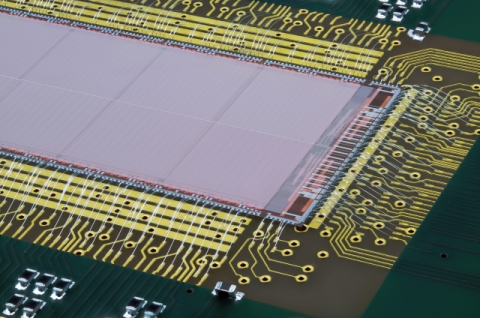
MOSAIX: Designing bent wafer-scale monolithic pixel sensors for the ALICE ITS3 upgrade
The ALICE detector is preparing a major upgrade to its Inner Tracking System (ITS) during LHC long shutdown 3 (2026-2030). This upgrade, called ITS3, will replace the three innermost tracking layers with three layers of cylindrical, 50 µm thick, 27…
Read more
Towards monitoring in Run 4 and beyond: LHC experiments exchange perspectives on data quality at the HL-LHC
In March of 2026, experts from ALICE, ATLAS, CMS and LHCb gathered at CERN for a dedicated workshop on Data Quality Monitoring (DQM), bringing together developers, coordinators and detector specialists to discuss how the LHC experiments monitor the…
Read more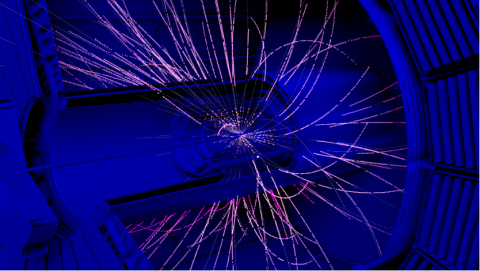
Online use of AI within ALICE
A reconstructed event of particles in the ALICE TPC, with data taken with the neural network cluster finding algorithm. Pink dots are reconstructed clusters. AI applications have rapidly expanded in everyday life, and ALICE, among other high-…
Read more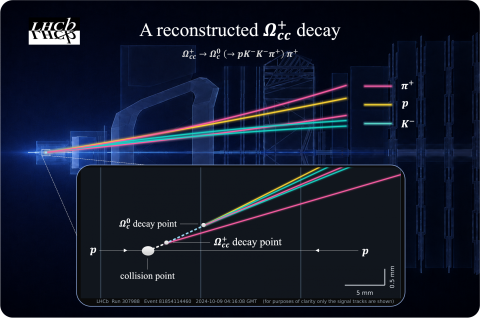
LHCb completes a long-awaited family of doubly charmed baryons
More than sixty years ago, particle physics was facing a problem of abundance. New subatomic particles were appearing in experiments, but there was not yet a clear organising principle to explain their relationships. In the early 1960s, Murray Gell-…
Read more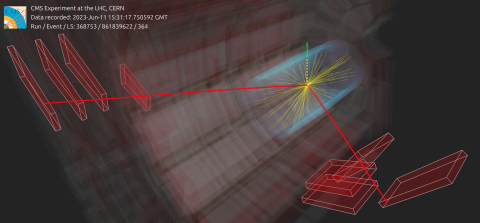
Out of the loop: CMS advances in the search for a rare Higgs boson decay
Completing the Higgs boson’s profile requires probing some of its rarest decay modes. Among the few still awaiting observation is the decay into a Z boson and a photon (H → Zγ), which occurs in only about one out of every ten thousand Higgs boson…
Read more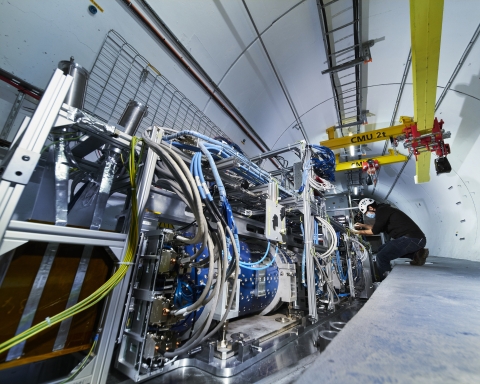
FASER opens new windows on dark sectors and TeV neutrino physics
The FASER experiment has presented a series of new results that highlight the growing breadth of its physics programme at the LHC. These include a search for dark photons with the main FASER detector, a first search for neutrino-induced charm…
Read more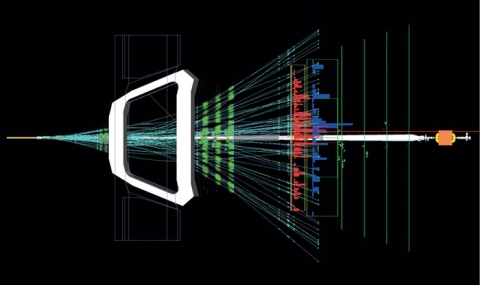
LHCb explores new light-ion territory with special LHC runs
In summer 2025, the LHC entered new territory. For the first time, the machine delivered p–O, O–O and Ne–Ne collisions to its experiments, as part of a short but technically demanding special ion run. For LHCb, the run provided a rare opportunity to…
Read more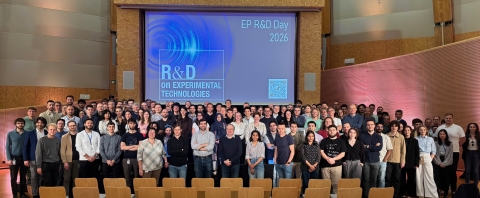
EP R&D Day 2026: technologies for the next generation of experiments
On 29 April 2026, colleagues from across CERN’s Experimental Physics Department gathered for the annual meeting dedicated to the strategic EP R&D programme on technologies for future experiments. The programme offered a broad update on progress…
Read more