
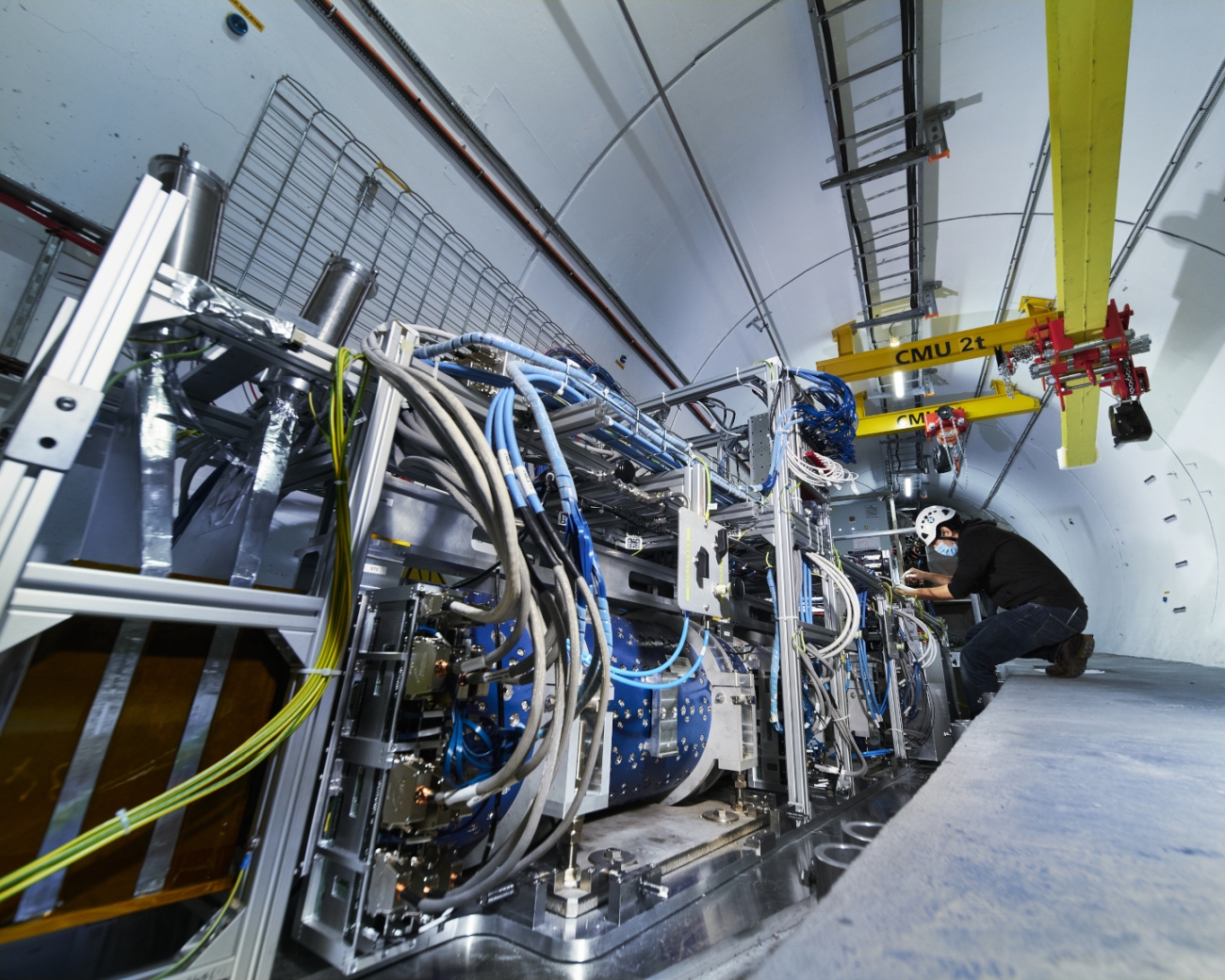
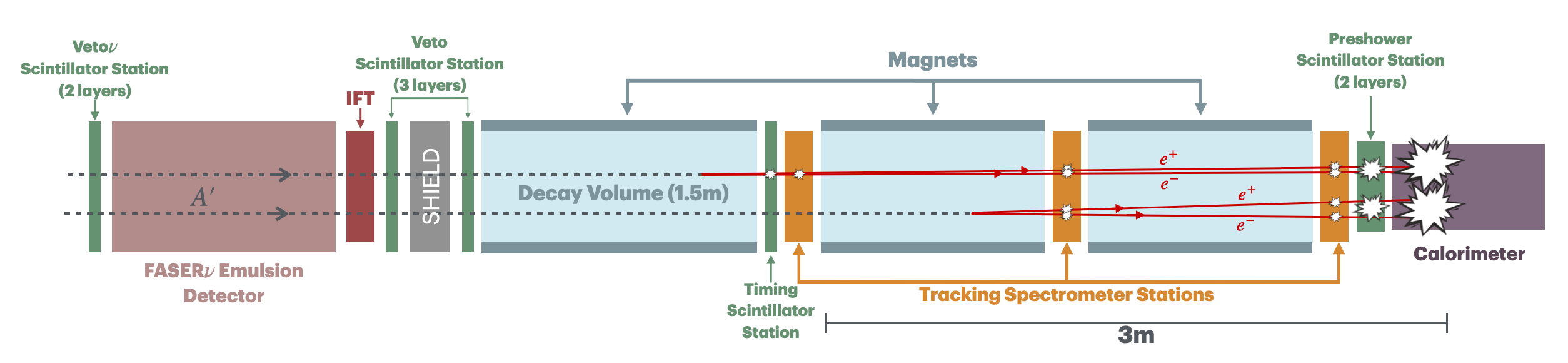
Schematic layout of the FASER detector, showing the FASERν emulsion detector, veto and timing scintillator stations, magnetic decay volume, tracking spectrometer and electromagnetic calorimeter. Long-lived particles such as dark photons could decay inside the detector volume into electron–positron pairs, leaving tracks in the spectrometer and energy deposits in the calorimeter.
Together, these results show how a compact experiment, located 480 metres downstream from the ATLAS interaction point, can explore physics that is difficult or impossible to access with the large general-purpose LHC detectors alone. FASER was designed to study particles produced in the far-forward direction — particles that travel almost exactly along the collision axis of the LHC beams. This region is intensely populated by high-energy particles emerging from proton-proton collisions, yet it remained largely unexplored before FASER was installed.
The experiment’s location in the TI12 tunnel is central to its scientific reach. Most ordinary particles produced at the ATLAS interaction point are absorbed by the rock and infrastructure between ATLAS and FASER, or deflected away by LHC magnets. Very weakly interacting particles, however — including neutrinos and hypothetical long-lived particles associated with dark sectors — can travel hundreds of metres and enter the detector. This gives FASER a dual role: it can search for new particles beyond the Standard Model, while also studying high-energy neutrinos produced at a collider.
New constraints on dark photons
The first result is a new search for dark photons, hypothetical particles that could mediate interactions between ordinary matter and a hidden “dark sector”. Dark photons are a well-motivated benchmark in many theories seeking to explain dark matter and other phenomena not accounted for by the Standard Model. If produced in LHC collisions, they could travel a long distance before decaying into visible particles, such as an electron–positron pair.
FASER’s new search uses data collected between 2022 and 2024, corresponding to an integrated luminosity of 177 fb⁻¹ at a centre-of-mass energy of 13.6 TeV. This represents a significant increase compared with the previous FASER dark-photon search, and is accompanied by an improved analysis strategy.
The earlier search focused on events with exactly two high-momentum tracks, as expected from a dark photon decaying into an electron and a positron. While this provided a clean and conservative signature, it also introduced an important inefficiency. In highly boosted decays, the two charged particles can be so close together that they are reconstructed as a single track. In other cases, electromagnetic showering or additional detector activity can produce more than two reconstructed tracks. Both situations could cause signal events to be rejected.
The new analysis therefore introduces two complementary signal regions. The first relaxes the two-track requirement and accepts events with at least one good high-momentum track. The second uses track segments in the downstream tracking stations, extending the search to dark photons that decay later in the detector, after the main decay volume but before the electromagnetic calorimeter.
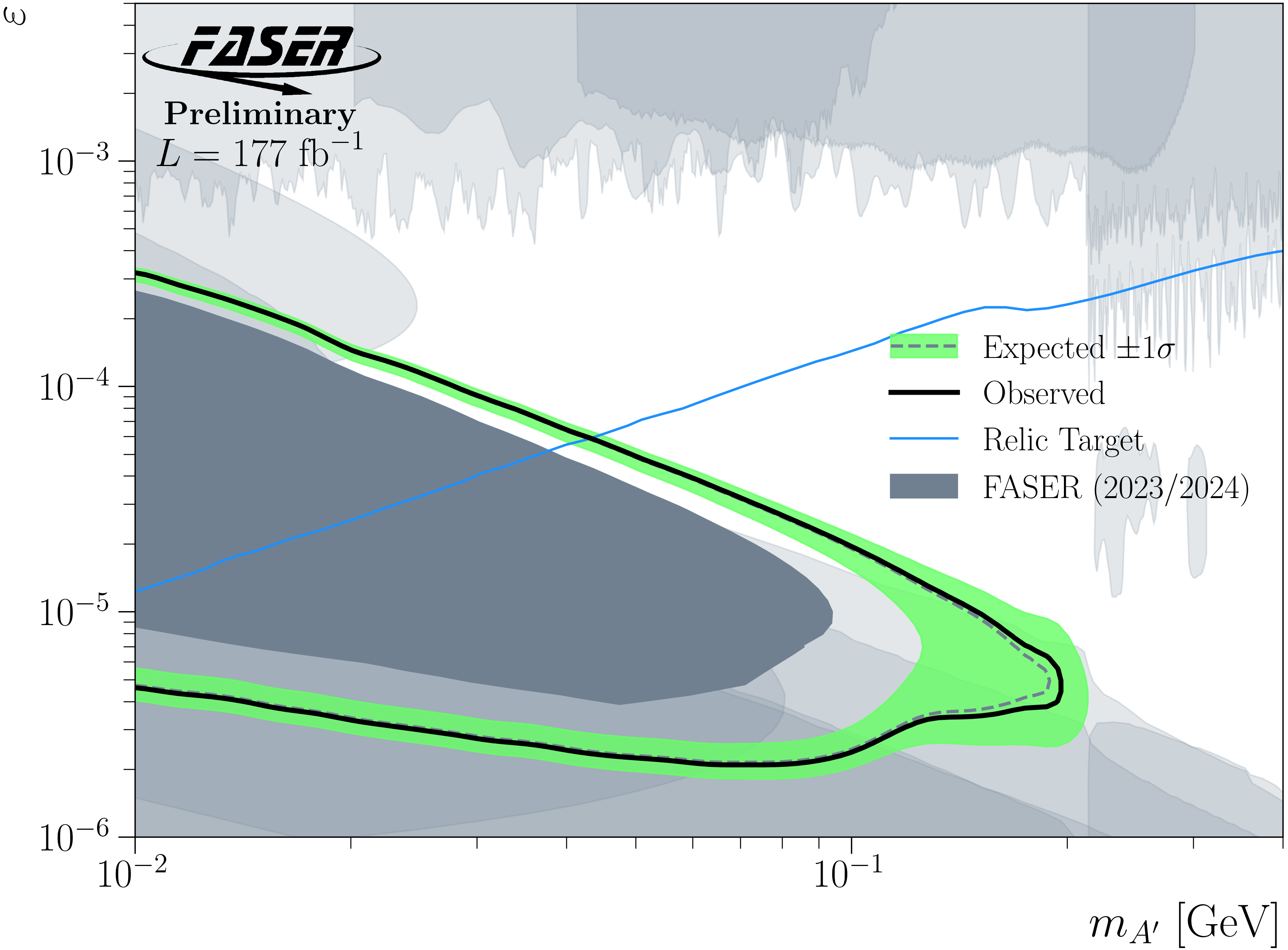
Preliminary FASER exclusion limits on dark photons using 177 fb⁻¹ of LHC Run 3 data collected between 2022 and 2024. The observed limit excludes dark photons with masses between about 10 and 150 MeV and couplings of around 10⁻⁵–10⁻⁴, ruling out part of the cosmologically viable parameter space in which dark-sector particles could account for the observed relic density of dark matter.
No candidate events were observed in either signal region. This null result is nevertheless a strong physics result. Since the analysis is nearly background-free, the absence of a signal allows FASER to set world-leading constraints on dark photons in a previously difficult-to-access region of parameter space, for couplings around 10⁻⁵–10⁻⁴ and masses around 10–150 MeV. The result demonstrates the unique power of the far-forward LHC environment for searches for long-lived particles.
Searching for charm in collider neutrino interactions
The second result turns to FASERν, the emulsion–tungsten neutrino detector placed in front of the main FASER detector. FASERν has already played a central role in establishing collider-neutrino physics, including the first direct observations of electron neutrinos produced at a particle collider. The new analysis takes the next step by searching for charm hadrons produced in high-energy electron- and muon-neutrino charged-current interactions.
Charm production in neutrino interactions is a rich physics process. In a charged-current interaction, a neutrino can scatter off a quark inside a nucleon, producing a charm quark through the exchange of a W boson. The charm quark then hadronises into short-lived particles such as D mesons or charmed baryons. Because these particles decay after travelling only tens to hundreds of micrometres, their identification requires extremely precise spatial resolution.
This is where the FASERν emulsion detector is particularly powerful. Nuclear emulsions act almost like photographic plates for charged particles, recording their trajectories with sub-micrometre precision. This allows researchers to look for displaced secondary vertices — tiny separations between the primary neutrino interaction point and the point where a short-lived charm hadron decays.
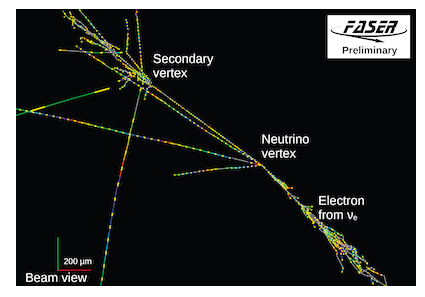
Event display from the FASERν emulsion detector showing a candidate event for a charm-hadron decay produced in a neutrino interaction. The image illustrates the key experimental signature targeted in the analysis: a primary neutrino interaction vertex followed by a displaced secondary vertex, where the short-lived charm hadron decays into several daughter particles.
The analysis uses neutrino interaction candidates recorded in the 2022 LHC data. Dedicated tools were developed to search for different charged-charm decay topologies, including kink signatures, connected daughter tracks and fully disconnected daughter tracks. A multivariate analysis is then used to distinguish possible charm decays from backgrounds such as hadronic interactions, electromagnetic showers, accidental combinations of tracks and multiple Coulomb scattering.
The analysis is still at an intermediate stage, with only a partial unblinding of the data performed so far and full unblinding expected in the near future. Even at this stage, the result is important because it validates the reconstruction and classification techniques needed to identify charm decays in the challenging environment of TeV-energy collider neutrinos.
The broader significance extends beyond charm itself. Charm production in neutrino scattering probes the strange-quark content of the nucleon, tests heavy-quark production and hadronisation, and can inform studies of parton distribution functions. The techniques developed here are also an essential step towards identifying tau-neutrino interactions, where the tau lepton likewise produces a displaced decay vertex. In this sense, the charm search is both a physics result and a methodological milestone for the future FASERν programme.
Measuring high-energy neutrinos in complementary ways
FASER is also moving beyond the first observation of collider neutrinos towards a broader programme of high-energy neutrino measurements. One of the strengths of the experiment is that it can approach this challenge in several complementary ways, using the FASERν emulsion detector, the electronic spectrometer and the electromagnetic calorimeter.
FASERν provides an ultra-high-resolution view of neutrino interactions, thus making it possible to reconstruct electron- and muon-neutrino interactions in great detail, study their topology, and measure interaction cross sections in a previously unexplored energy range.
Recent FASERν measurements use the 2022 LHC exposure with an enlarged analysed target mass. Candidate events are selected by reconstructing neutral vertices in the emulsion detector and identifying the charged lepton associated with the interaction: an electromagnetic shower for electron neutrinos or a penetrating muon track for muon neutrinos. For the first time with the FASERν emulsion detector, the energy of muon-neutrino events has been reconstructed event by event, allowing the collaboration to measure the muon-neutrino cross section as a function of energy.
At the same time, the electronic FASER detector provides a different and highly complementary handle on collider neutrinos. When a muon neutrino interacts with material in or near FASER, it can produce a muon that is reconstructed as a track in the spectrometer. By using the scintillator system in front of FASERν, researchers can identify muons that do not originate from ATLAS but instead emerge from neutrino interactions in FASER. Since the spectrometer measures the bending direction of charged particles in a magnetic field, it can also determine the charge of the muon and therefore distinguish muon-neutrino from muon-antineutrino interactions.
This approach makes it possible to perform neutrino measurements on a faster timescale than with emulsions and provides direct access to momentum and charge information. Building on the first observation of collider neutrinos and subsequent muon-neutrino flux and cross-section measurements, FASER has now used a substantially larger Run 3 dataset to measure neutrino energy and rapidity at the LHC. These results will help improve theoretical modelling of both the neutrino flux and the interaction cross sections, and provide new information about the particles produced in the far-forward direction.
Rapidity is a way of describing the direction of particles with respect to the LHC beamline. In the FASER context, measuring the neutrino flux as a function of energy and rapidity helps connect the observed neutrinos to the unstable particles that produced them, such as light mesons, strange mesons and charm hadrons. To make the results easier to compare with theoretical predictions, the analysis uses unfolding techniques to correct for detector effects and infer the underlying neutrino distributions.
FASER has also demonstrated a new method for measuring electron-neutrino interactions using its electromagnetic calorimeter. Neutrinos usually pass through the detector without leaving any trace. On rare occasions, however, an electron neutrino can interact directly in the calorimeter, producing a large energy deposit with no corresponding activity in the upstream detector systems. Such events appear almost as if energy has suddenly emerged in the calorimeter from nowhere.
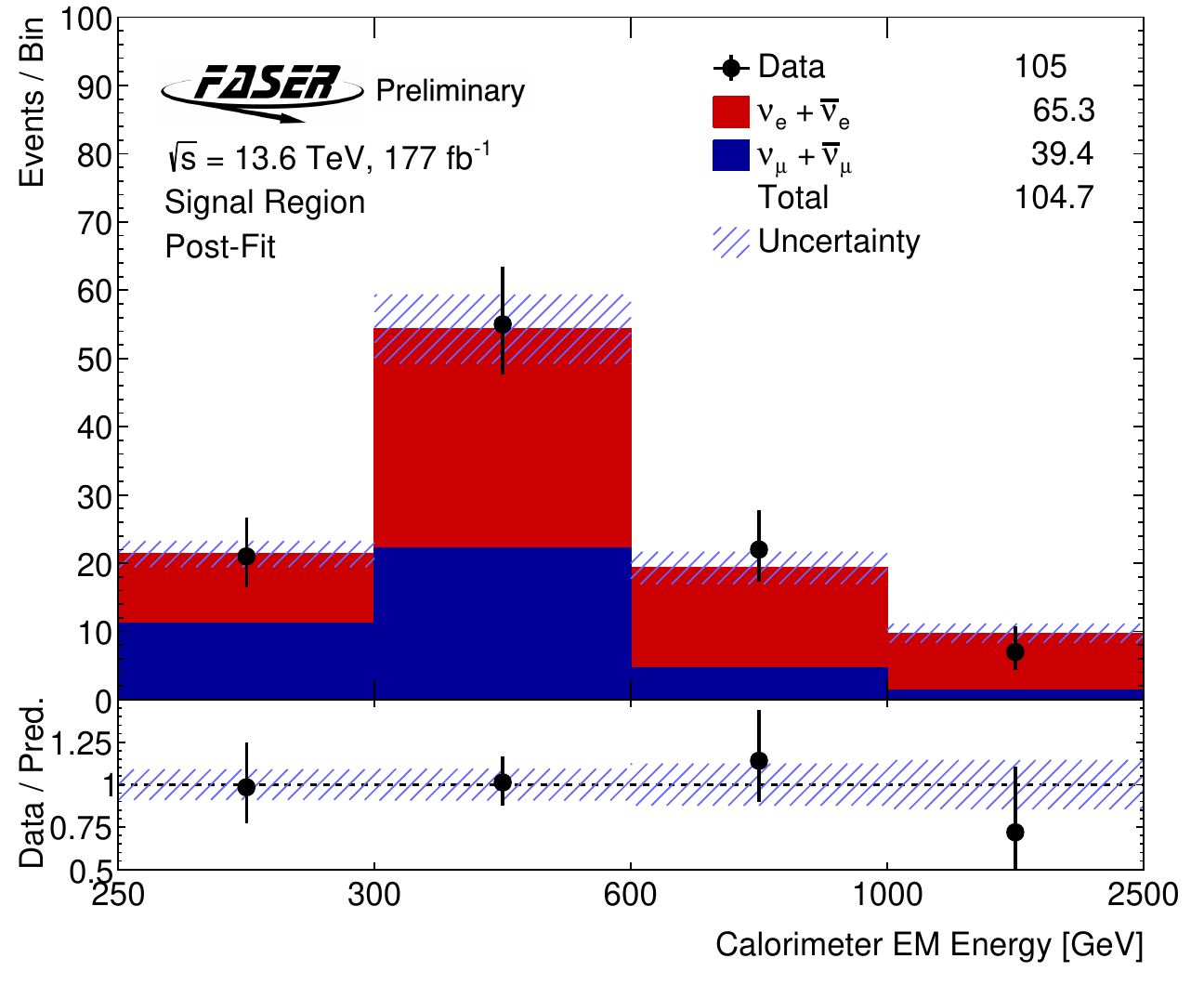
Calorimeter energy distribution for high-energy neutrino candidates in FASER. The stacked red and blue histograms show the fitted contributions from electron-neutrino and muon-neutrino interactions, while the black points show the observed data. The result demonstrates how the electromagnetic calorimeter can provide an independent handle on electron-neutrino interactions at TeV energies.
Using Run 3 data collected between 2022 and 2024, FASER observed a sample of high-energy calorimeter events and separated the electron-neutrino component from the muon-neutrino background using information from previous muon-neutrino measurements. This result provides a second, independent method for accessing electron neutrinos at the highest human-made neutrino energies. It is particularly striking because the calorimeter was not originally designed for this purpose; the method emerged from the collaboration’s ability to recognise and exploit an unexpected experimental signature.
Together, these measurements show that FASER is not relying on a single technique to study collider neutrinos. The emulsion detector offers extraordinary spatial precision; the spectrometer provides charge and momentum information for muon-neutrino studies; and the calorimeter opens an additional route to electron-neutrino measurements. By combining these approaches, FASER is turning the LHC into a laboratory for TeV-scale neutrino physics, probing neutrino interactions, forward-particle production and QCD in an energy regime that was previously inaccessible to accelerator-based experiments.
A growing far-forward physics programme
Taken together, the latest results highlight the scientific role that FASER is beginning to play at the LHC. The dark-photon search shows how the experiment can probe long-lived, weakly interacting particles that may connect the Standard Model to a hidden sector. The charm search demonstrates that FASERν can begin to study the detailed structure of neutrino interactions at TeV energies. The neutrino measurements show that collider neutrinos are becoming a quantitative tool for precision physics, with several complementary detector technologies providing different experimental handles on the same frontier.
These results also illustrate the complementarity between the main FASER detector and FASERν. The former is optimised for long-lived particle searches using electronic detector systems, tracking and calorimetry, while also enabling fast neutrino measurements through its spectrometer and calorimeter. The latter uses emulsion technology to reconstruct neutrino interactions with extraordinary spatial precision. Together, they transform the far-forward region of the LHC into a laboratory for both new-particle searches and high-energy neutrino physics.
FASER’s latest results therefore mark a transition. The experiment has moved beyond demonstrating that the far-forward region can be instrumented and that collider neutrinos can be observed. It is now developing a broader physics programme: setting competitive limits on dark-sector particles, developing the tools needed to identify heavy-flavour production in neutrino interactions, and measuring neutrino cross sections in a previously unexplored energy range.
As more Run 3 data are analysed, FASER and FASERν will continue to explore this unique frontier. Whether searching for particles that could illuminate the dark sector or using LHC neutrinos to probe the Standard Model at TeV energies, the experiment is showing that even a small detector, placed in the right location, can open a large window on fundamental physics.
Note: The author is grateful to Brian Petersen from the FASER collaboration for his valuable input and careful comments during the preparation of this article.


