
BASE experiment scientist recognised with UPAP Early Career Scientist for coherent antiproton spin spectroscopy

Dr Barbara Maria Latacz, CERN scientist and lead author of the BASE study, works on the trap electronics used to control single antiprotons for high-precision antimatter measurements.
Barbara Latacz, CERN research scientist and technical coordinator of the BASE experiment, has received an IUPAP Early Career Scientist Prize in the section “particles and fields” for her contributions to one of the most recent breakthroughs in antimatter research: the first coherent spectroscopy of a single antiproton spin.
The prize recognises Latacz for her contributions to the development of the first coherent spectroscopy of a single antiproton spin in the BASE experiment at CERN. This establishes the first antimatter quantum bit and has the potential to improve precision antiproton magnetic moment measurements by at least a factor of 100.
The award highlights a major step forward for precision antimatter physics at CERN’s Antimatter Factory. In a recent paper published in Nature, the BASE collaboration reported that it had kept a single trapped antiproton — the antimatter counterpart of the proton — oscillating coherently between two quantum spin states for almost a minute. The result marks the first demonstration of an antimatter quantum bit, or qubit, and opens the way to substantially improved comparisons between matter and antimatter.
Like protons, antiprotons behave as tiny magnets. Their quantum spin can point in one of two directions, often described as “up” and “down”. Measuring how this spin flips is a powerful way to determine the particle’s magnetic moment. For BASE, which compares the properties of protons and antiprotons with extreme precision, this is a direct route to testing charge-parity-time, or CPT, symmetry — a cornerstone of the Standard Model, which requires matter and antimatter to behave identically under the combined reversal of charge, spatial coordinates and time.
This question is central to modern fundamental physics. According to current understanding, matter and antimatter should have been created in nearly equal amounts in the early Universe. Yet the observable Universe is overwhelmingly made of matter. Any difference between the magnetic moments of the proton and antiproton would signal a violation of CPT symmetry and point to physics beyond the Standard Model.
Until now, BASE’s antiproton magnetic-moment measurements relied on an incoherent spectroscopy technique. The collaboration had already shown that the magnitudes of the proton and antiproton magnetic moments agree to within a few parts per billion. However, the quantum transitions used in these measurements were disturbed by magnetic-field fluctuations and by the measurement process itself. In a substantial upgrade to the experiment, the BASE team suppressed these sources of decoherence, enabling the first coherent spectroscopy of a single antiproton's spin.
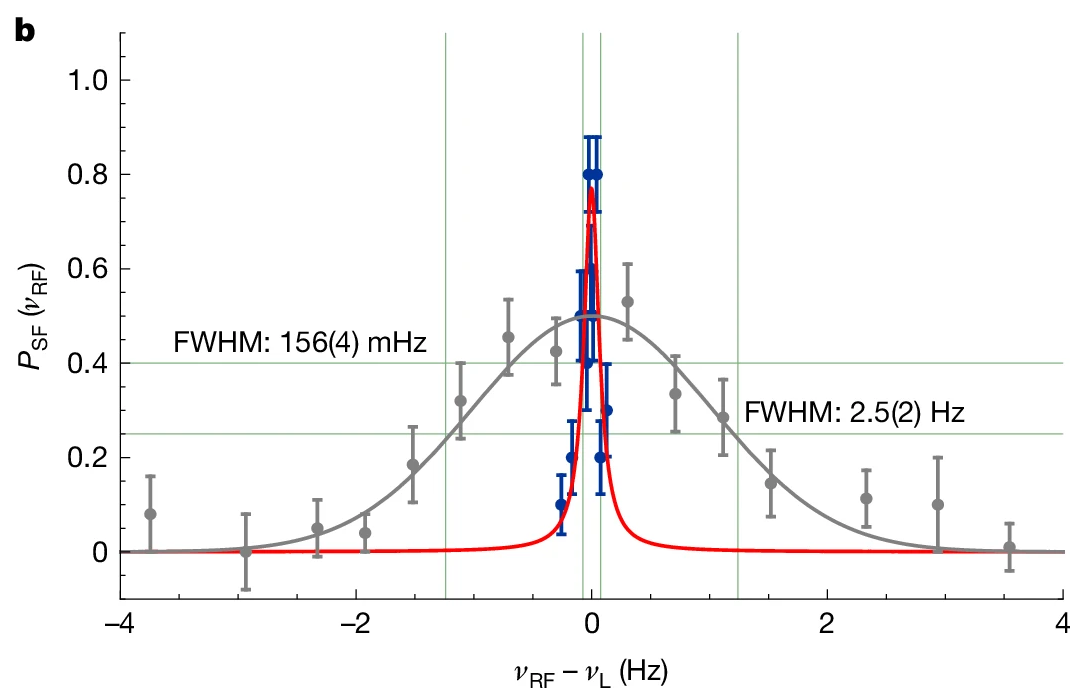
Figure 1: Coherent spin-resonance measurement of a single antiproton by the BASE experiment. The new coherent spectroscopy method produces a resonance with a higher signal-to-noise ratio and a linewidth about 16 times narrower than in the previous antiproton magnetic-moment measurement, opening the way to substantially improved precision tests of matter–antimatter symmetry. Image from Latacz, B.M., Erlewein, S.R., Fleck, M. et al. Coherent spectroscopy with a single antiproton spin. Nature 644, 64–68 (2025). https://doi.org/10.1038/s41586-025-09323-1
The achievement can be compared to pushing a child on a swing. With the right push, the swing moves back and forth in a smooth rhythm. In BASE’s experiment, the “swing” is the spin of a single trapped antiproton, oscillating between its two quantum states under carefully controlled electromagnetic conditions. Unlike an ordinary swing, however, the antiproton is a quantum system: when unobserved, its spin can exist in a superposition of states.
“This represents the first antimatter qubit and opens up the prospect of applying the entire set of coherent spectroscopy methods to single matter and antimatter systems in precision experiments,” explains BASE spokesperson Stefan Ulmer. “Most importantly, it will help BASE to perform antiproton moment measurements in future experiments with 10- to 100-fold improved precision.”
Although qubits are best known as the basic units of quantum computers, the antimatter qubit demonstrated by BASE is not intended for immediate quantum-computing applications. Its significance lies instead in fundamental physics: it provides a new quantum-sensing tool for probing the properties of a single antimatter particle with unprecedented control.
The IUPAP prize also recognises Latacz’s role in a broader sequence of technical advances by the BASE collaboration. In 2024, she was the lead author of a study reporting a major breakthrough in rapid antiproton cooling. BASE reduced the time needed to cool an antiproton from 15 hours to just 8 minutes — a decisive improvement for precision measurements, since a clear measurement of antiproton spin transitions requires the particle to be cooled below 200 millikelvin. This advance transformed a measurement campaign that would otherwise have required years of continuous operation into one that could be carried out on a much shorter timescale.
Together, rapid cooling and coherent spin control address two of the central challenges in antiproton precision spectroscopy: preparing single antiprotons in the right experimental conditions and manipulating their spin quantum state without destroying its coherence. The result is a platform that can support a new generation of precision tests of matter–antimatter symmetry.
This is not the first recent recognition of Latacz’s contributions to the BASE collaboration's work. In November 2025, she received the Boeing Quantum Creators Prize at the Chicago Quantum Summit for her contributions to quantum-limited measurement technologies to determine the antiproton magnetic moment with at least 100-fold improved accuracy. Together, the two awards show how BASE’s advances sit at the intersection of quantum science and precision antimatter physics: techniques developed to control a single antiproton as a quantum system are now becoming tools to test some of the most fundamental symmetries of nature.
An even larger leap in precision is expected with BASE-STEP, a transportable antiproton trap developed to move trapped antiprotons away from CERN’s Antimatter Factory to laboratories with calmer magnetic environments. Magnetic-field fluctuations from the accelerator environment currently limit the ultimate precision of the measurements. By transporting antiprotons to a dedicated precision laboratory, BASE aims to extend spin coherence times and further improve its tests of CPT symmetry.
The recognition is also part of a remarkable record for the BASE collaboration. Over the past decade, BASE scientists have received four IUPAP awards, reflecting the sustained impact of the experiment and its ability to combine precision measurement, quantum control and advanced antimatter handling. Previous BASE recipients include Stefan Ulmer, who received the IUPAP Young Scientist Prize in Fundamental Metrology in 2014 for his achievements in establishing non-destructive quantum-limited spectroscopy with single proton and antiproton spins. In addition, the BASE scientists Andreas Mooser and Christian Smorra received the IUPAP Young Scientist Prize in Atomic, Molecular and Optical Physics in 2019 for precision measurements of the magnetic moments of the proton and the antiproton, carried out with parts-per-billion resolution. Barbara Latacz’s award, in the IUPAP C11 branch “particles and fields”, adds a new recognition to this sequence and underlines the strength of the BASE collaboration across successive generations of young researchers and across very different fields of physics, uniting quantum metrological measurement approaches and particle physics in an impactful way.
IUPAP Early Career Scientist Prizes recognise the contributions of early-career physicists within the subfields of the Union’s scientific commissions. Formerly known as the Young Scientist Prizes, they were renamed to emphasise that eligibility is based on career stage rather than chronological age. Successful candidates have up to eight years of research experience following their PhD, excluding career interruptions. The award consists of a certificate, a medal and a monetary prize, and awardees are featured through IUPAP communication channels.
For BASE, the award is both an individual recognition and a celebration of a wider experimental programme. By developing new ways to cool, control, transport, and measure antimatter, the collaboration continues to push the precision frontier — and to use CERN’s unique Antimatter Factory to ask one of the most fundamental questions in physics: whether matter and antimatter are truly mirror images of one another.


