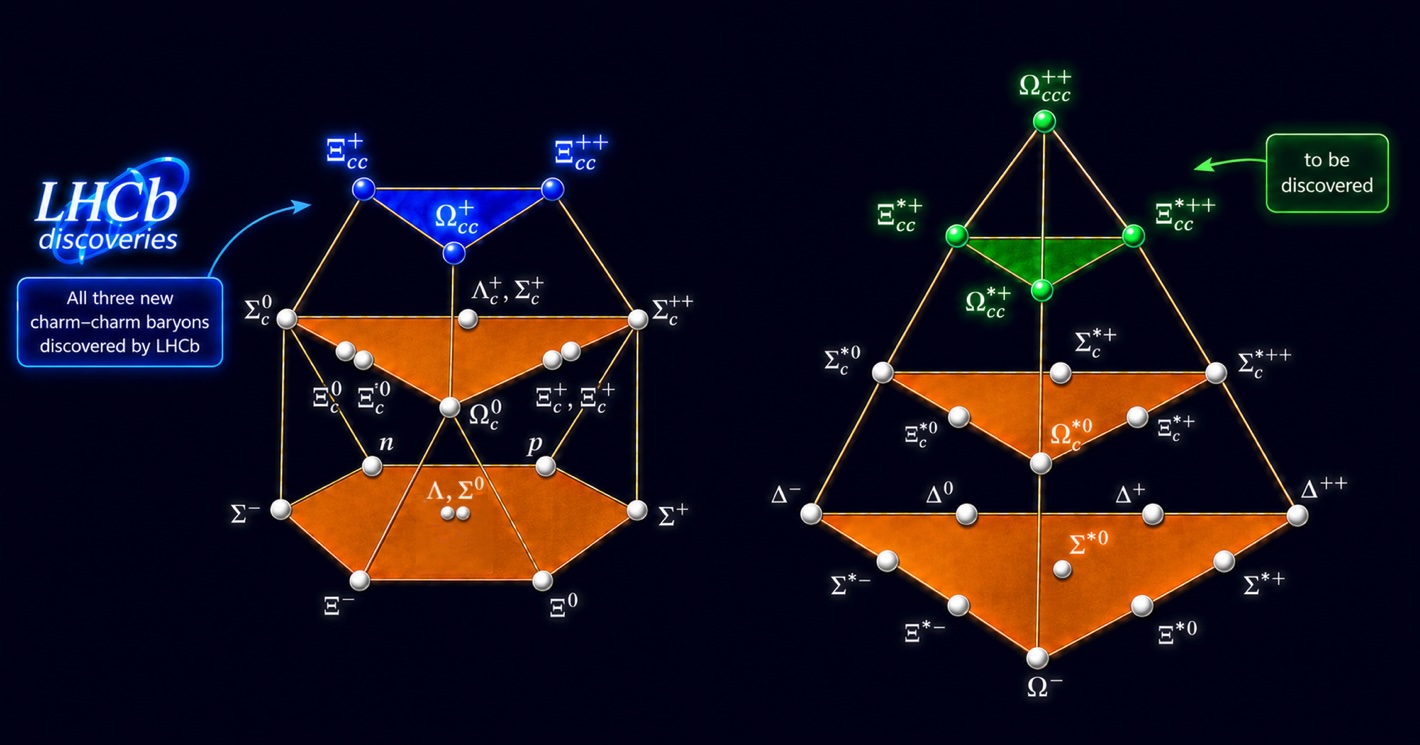
One of the most celebrated successes of this idea was the prediction of the Ω− baryon, a particle made of three strange quarks. Its subsequent discovery in a bubble-chamber photograph at Brookhaven in 1964 became a landmark confirmation of the new classification scheme and helped establish the quark model as a powerful language for describing matter.
Today, LHCb has added a new page to this story. At the Beauty 2026 conference in Maastricht, the collaboration announced the observation of the doubly charmed Ωcc+ baryon, a particle made of two charm quarks and one strange quark. With this result, LHCb completes the family of weakly decaying doubly charmed baryons expected in the ground-state spin-1/2 sector: Ξcc++, Ξcc+ and Ωcc+.
The discovery is not only the observation of another new particle. It is the closing of a long-standing gap in hadron spectroscopy and a demonstration of the upgraded LHCb detector's new reach.
A new laboratory for the strong force
Baryons are particles made of three quarks. Protons and neutrons, which make up atomic nuclei, are the most familiar examples. But the Standard Model allows many other combinations, including baryons containing heavy quarks such as charm or beauty. Most baryons observed so far contain at most one heavy quark. Doubly heavy baryons, by contrast, contain two heavy quarks bound together with a lighter quark.
This makes them especially interesting for quantum chromodynamics, or QCD, the theory of the strong interaction. At high energies, QCD can often be treated with powerful perturbative methods. At the lower energies relevant for the binding of quarks inside hadrons, however, the strong force becomes non-perturbative and much harder to calculate from first principles. Hadron spectroscopy — the measurement of the spectrum, masses, lifetimes and decays of hadrons — is therefore one of the most direct ways to test our understanding of this regime.
Doubly charmed baryons offer a particularly clean and fascinating system. In a simplified picture, the two heavy charm quarks can form a compact pair, with the lighter quark moving around them. This is quite different from ordinary baryons, where three light quarks all participate in a more intricate dynamical motion. Measuring these particles, therefore, helps theorists test models of how quarks bind together, how the strong force behaves at different scales, and how the properties of hadrons emerge from the underlying theory.
The Ωcc+ is the strange member of this doubly charmed family. It is analogous, in an extended sense, to the historical Ω− baryon, where the Ω− contains three strange quarks, the Ωcc+ contains two charm quarks and one strange quark. It had been predicted for more than half a century, but had not previously been observed experimentally.
From bubble chambers to the upgraded LHCb detector
The contrast between the discovery of the Ω− in the 1960s and the observation of the Ωcc+ today illustrates how much experimental particle physics has changed.
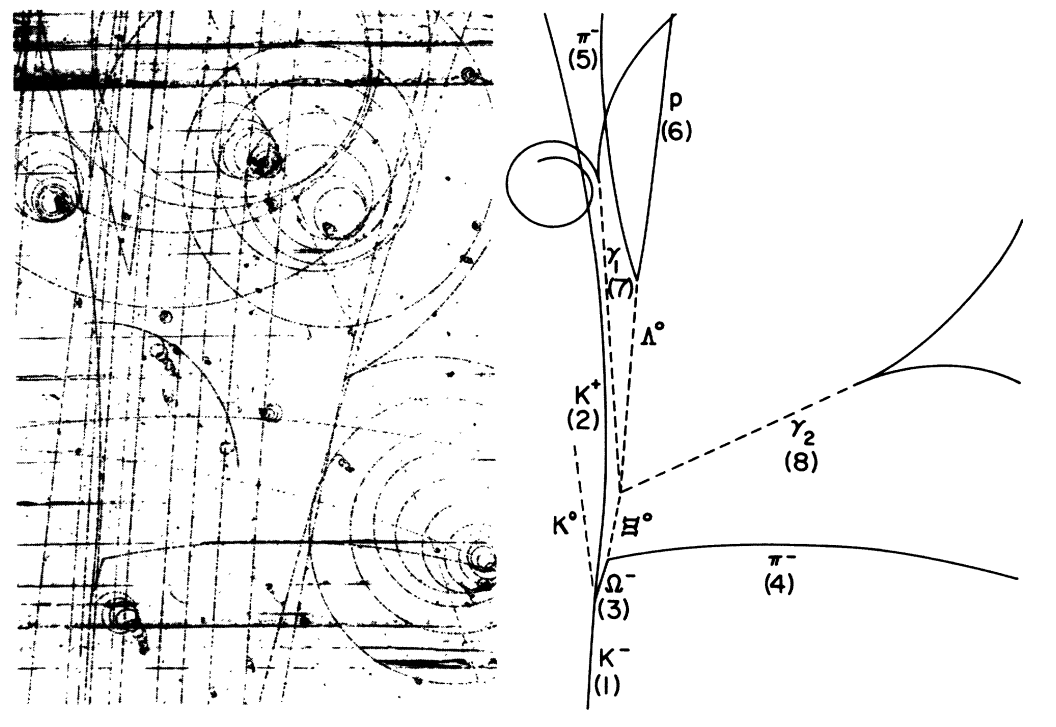
The historic bubble-chamber photograph that revealed the Ω⁻ baryon at Brookhaven in 1964. Predicted by the Eightfold Way classification scheme proposed by Murray Gell-Mann and Yuval Ne’eman, the Ω⁻ provided a striking confirmation of the emerging quark model. More than sixty years later, LHCb’s observation of the doubly charmed Ωcc+ baryon echoes this milestone, completing another long-predicted family of particles in the hadron spectrum.
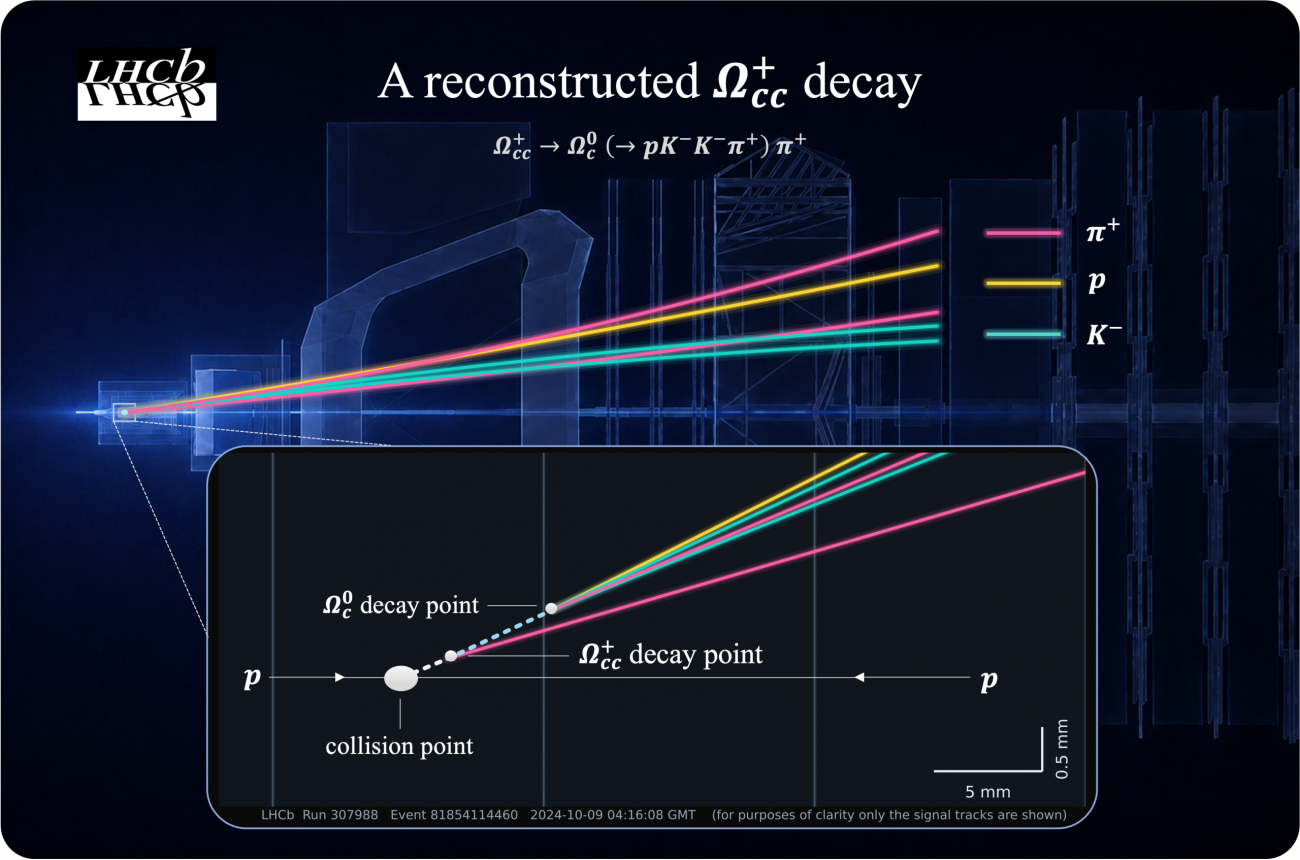
The Ω− was discovered through the painstaking visual scanning of bubble-chamber photographs. The Ωcc+, by contrast, was found in proton–proton collision data recorded by the upgraded LHCb detector in 2024. Instead of a single photograph, the modern signature is reconstructed from charged-particle tracks, displaced decay vertices, and invariant-mass distributions selected from the enormous data stream produced by the LHC.
The Ωcc+ was observed through its decay into an Ωc0 baryon and a pion. The Ωc0 is reconstructed from its decay into a proton, two kaons, and a pion, resulting in five charged tracks in the detector. By tracing these tracks back to their points of origin, physicists identify the characteristic topology of a short-lived particle travelling a small but measurable distance before decaying.
In the Ωc0π+ mass spectrum, LHCb observes a clear peaking structure at around 3726 MeV/c2. The presentation of the result reports a local significance above eight standard deviations, well beyond the conventional threshold required to claim an observation. The peak remains significant after applying a tight requirement on the decay time, supporting the interpretation that the particle is weakly decaying, as expected for a doubly charmed baryon.
Why LHCb Upgrade I matters
This result is also a powerful demonstration of LHCb Upgrade I. The upgraded experiment is, in many respects, a brand-new detector: around 90% of its sensitive detector elements were replaced, along with new readout electronics. Most importantly, LHCb now operates with a fully software-based trigger, removing the previous hardware L0 trigger. This transformation allows the experiment to run at up to five times higher instantaneous luminosity by the end of Run 3, while significantly improving the efficiency for hadronic final states by a factor of about two to four. For a fully hadronic decay chain such as Ωcc+ → Ωc0π+, with Ωc0 reconstructed from a proton, two kaons and a pion, this improved real-time selection capability is central to turning the enormous LHC collision rate into a clean spectroscopy signal.
This matters directly for discoveries such as Ωcc+. The decay channel used in the analysis is fully hadronic: it involves protons, kaons and pions rather than cleaner signatures such as muons or electrons. In previous running periods, hardware-trigger limitations made many hadronic final states more difficult to select efficiently. The removal of the hardware L0 trigger and the move to a flexible software trigger significantly improve LHCb’s ability to retain and reconstruct such events.
The observation of Ωcc+, demonstrates how the upgraded experiment can turn the challenging environment of proton–proton collisions into a precision spectroscopic tool. Rare hadronic signals that were once far harder to isolate can now be selected with much higher efficiency, opening new possibilities for charm and beauty physics in Run 3 and beyond.