
SME
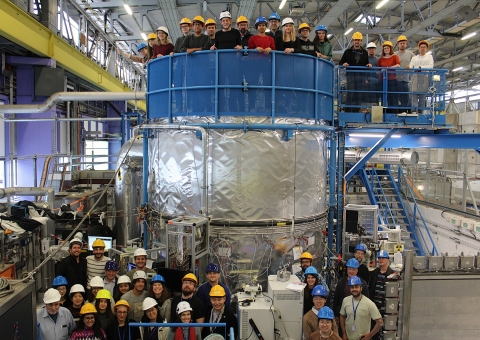
CLOUD experiment reveals a major new source of marine aerosol particles
Clouds form when water vapour condenses onto tiny airborne particles known as aerosols. Once these particles grow larger than about 50 nanometres, they can act as cloud condensation nuclei, or CCN, on which cloud droplets form. Increased aerosol…
Read more
The ISOLDE Improvement Programme
The ISOLDE Improvement Programme (IIP) brings together a series of upgrades and consolidation activities to maintain and further develop the ISOLDE facility. The programme includes projects addressing the accelerator infrastructure, beam production…
Read more
BASE experiment scientist recognised with UPAP Early Career Scientist for coherent antiproton spin spectroscopy
Dr Barbara Maria Latacz, CERN scientist and lead author of the BASE study, works on the trap electronics used to control single antiprotons for high-precision antimatter measurements. Barbara Latacz, CERN research scientist and technical…
Read more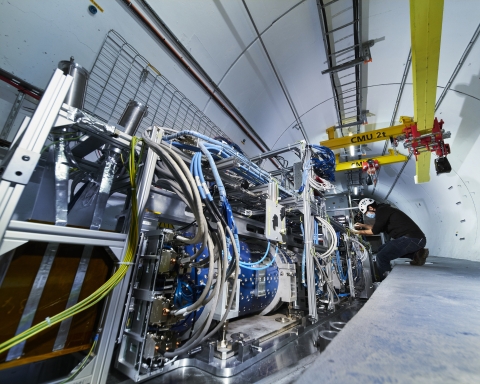
FASER opens new windows on dark sectors and TeV neutrino physics
The FASER experiment has presented a series of new results that highlight the growing breadth of its physics programme at the LHC. These include a search for dark photons with the main FASER detector, a first search for neutrino-induced charm…
Read more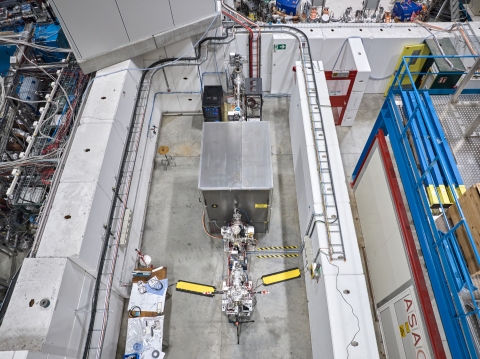
PUMA - Antiprotons as a precision probe for the tail of nuclear density
Understanding the nuclear structure of atomic nuclei away from the valley of stability remains one of the central challenges of nuclear physics and astrophysics. In particular, the dilute outer regions of neutron-rich nuclei can exhibit phenomena…
Read more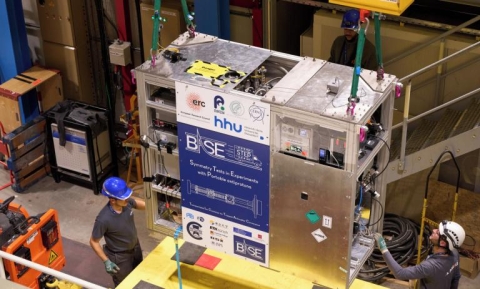
Moving antimatter beyond the lab
For decades, antimatter experiments have been bound to a single place: the laboratory in which the particles are produced and trapped. At CERN’s Antimatter Factory, antiprotons are routinely produced, decelerated and confined in Penning traps,…
Read more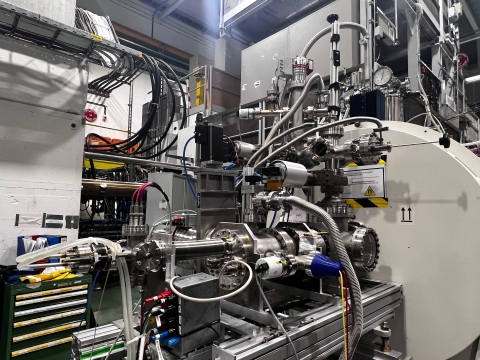
Probing lithium dynamics at buried interfaces with β-detected NMR at ISOLDE
Spin-polarised probes have been central to nuclear and particle physics since the discovery of parity violation by Chien-Shiung Wu in 1956, who detected asymmetric emission of β-radiation from low-temperature 60Co in a magnetic field. The…
Read more
NA62 sharpens the picture of one of nature’s rarest particle decays
The NA62 experiment at CERN has achieved a major milestone in flavour physics with the first observation of one of the rarest particle decays ever measured. The process — the decay of a positively charged kaon into a pion and a neutrino–antineutrino…
Read more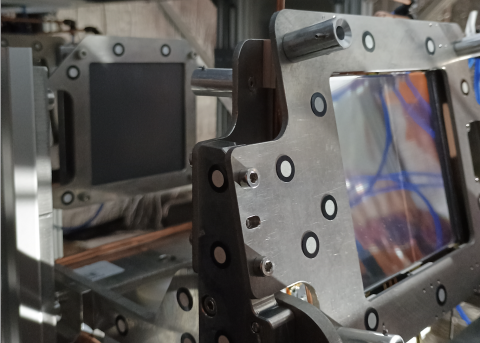
MUonE: A new path to hadronic vacuum polarization and the running of α
Promising results Promising results - A test run for the proposed MUonE experiment took place at CERN in the summer. The image shows a 20 mm thick graphite scattering target (left) and a silicon strip tracking module (right). Credit:…
Read more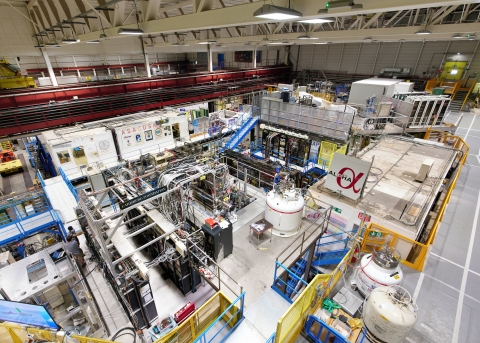
Sympathetic Cooling Opens a New Era for Antihydrogen at CERN
A major milestone has been reached at CERN’s Antimatter Factory. Using an innovative technique to cool positrons with laser-cooled beryllium ions, the ALPHA collaboration has increased the rate of antihydrogen production by a factor of eight. The…
Read more