
NA62 sharpens the picture of one of nature’s rarest particle decays
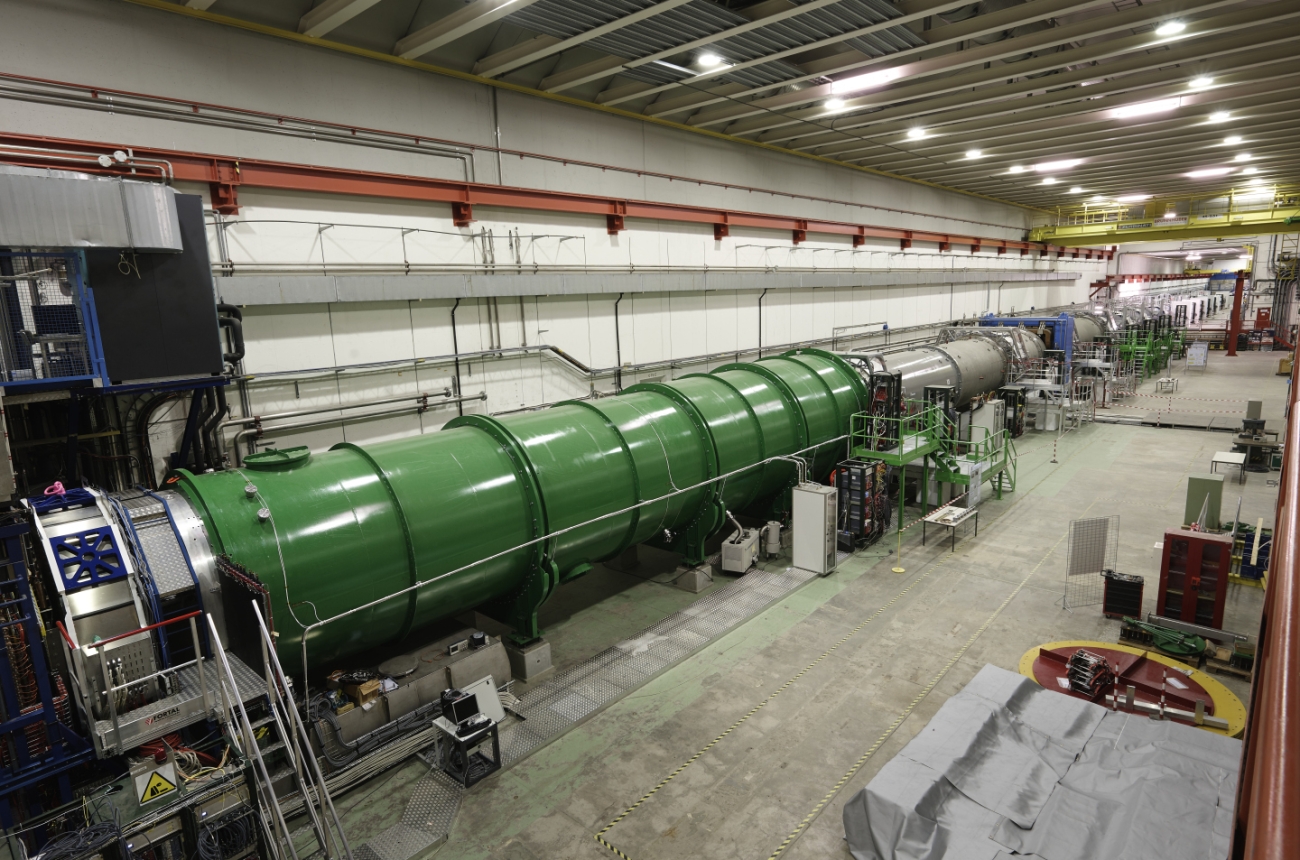
The NA62 experiment at CERN has achieved a major milestone in flavour physics with the first observation of one of the rarest particle decays ever measured. The process — the decay of a positively charged kaon into a pion and a neutrino–antineutrino pair — occurs less than once in ten billion kaon decays. Yet precisely because of its rarity, it offers an exceptionally clean probe of the Standard Model and a powerful window onto potential new physics.
Recent analyses incorporating the 2023–2024 data and new machine-learning-based reconstruction techniques have now significantly improved the precision of the measurement.Using the complete dataset collected up to the end of 2024, the NA62 collaboration reports an updated branching ratio of (9.6 +1.9 −1.8 ) × 10−11, with the uncertainty reduced by about 40% compared to the previous result. This new measurement is in excellent agreement with the Standard Model prediction.
A “golden mode” for flavour physics
The decay 𝐾+→𝜋+𝜈𝜈ˉ occupies a special place in particle physics. It proceeds through a flavour-changing neutral current process — a transition from a strange quark to a down quark — which is forbidden at the simplest level of the Standard Model and can occur only through higher-order quantum loops. As a result, the decay is extremely suppressed, with a branching ratio predicted to be around 8×10⁻¹¹.
This suppression makes the decay exceptionally sensitive to the influence of new particles or interactions that might appear in those loops. Even small deviations from the predicted rate could reveal physics beyond the Standard Model. Because theoretical uncertainties are unusually small — below the level of a few per cent — the decay has long been regarded as a “golden channel” for precision tests of flavour physics.
The NA62 experiment was designed specifically to measure this decay with unprecedented sensitivity.
Producing and detecting rare kaon decays
NA62 operates in CERN’s North Area using a high-intensity proton beam from the Super Proton Synchrotron (SPS). Protons with energies of 400 GeV strike a beryllium target, producing a secondary beam of particles that includes positively charged kaons. Each second, almost a billion secondary particles emerge from the target; roughly 6% of these are kaons.
The experiment employs a “decay-in-flight” technique. Kaons are tagged and tracked as they enter a long evacuated decay region where a fraction of them decay. The signature sought by NA62 is deceptively simple: a single outgoing charged pion accompanied by missing energy carried away by two neutrinos.
In practice, isolating such events is extraordinarily challenging. The overwhelming majority of kaons decay through much more common channels, such as 𝐾+→𝜇+𝜈 or 𝐾+→𝜋+𝜋0. The experiment must therefore reject backgrounds many orders of magnitude more frequent than the signal while maintaining high efficiency for the rare decay itself.
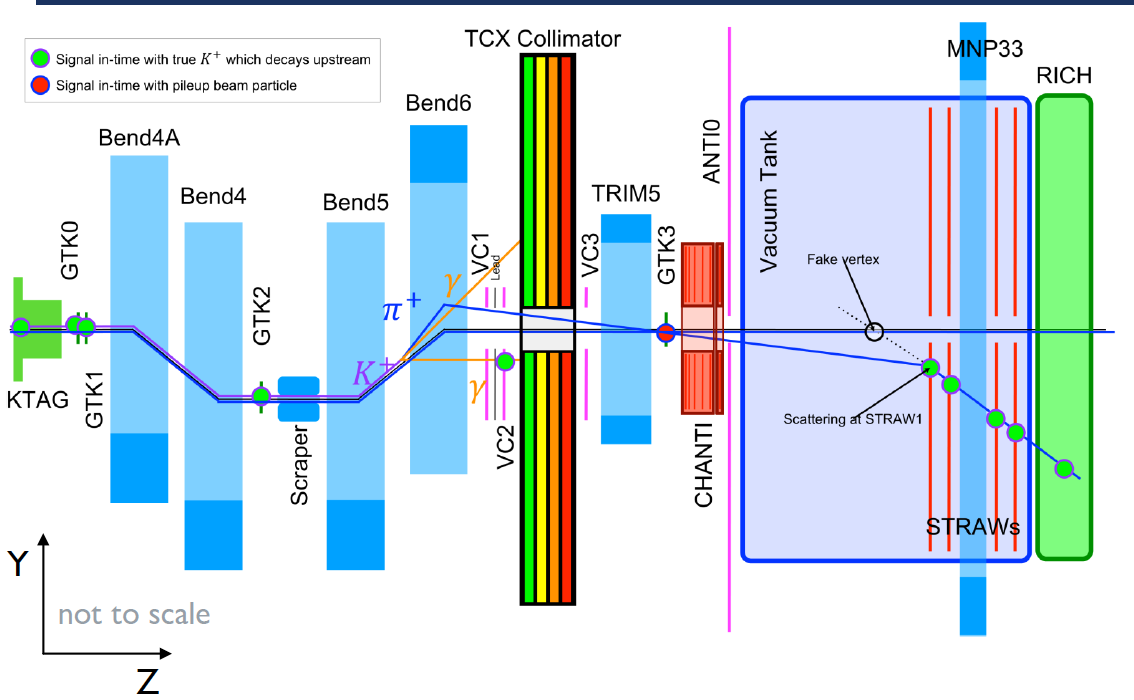
A schematic view of the NA62 beamline illustrating how upstream kaon decays and pileup particles can produce fake vertices, and how dedicated detector elements suppress these backgrounds. Credit: R. Fiorenza, NA62 Collaboration (La Thuile 2026)
To achieve this, NA62 combines a sophisticated tracking system, precise timing detectors and hermetic photon veto systems capable of identifying even tiny traces of unwanted particles. By reconstructing the kinematics of each event — particularly the missing mass derived from the kaon and pion momenta — the experiment can isolate the region where signal events are expected to appear.
From evidence to observation
The search for this ultra-rare decay has progressed steadily over the past decade. Early analyses using data collected between 2016 and 2018 provided the first evidence for the process. Subsequent runs with upgraded detectors and higher beam intensity significantly increased the dataset. In 2024, the NA62 collaboration announced the first observation of the decay with a statistical significance above five standard deviations. Combining data taken between 2016 and 2022, the analysis identified 51 candidate events over an estimated background of about 18 and measured a branching ratio of B (K+→π+νν) = (13.0 +3.3 −3.0 ) × 10−11.
While that value lay somewhat above the Standard Model expectation, the uncertainties were still large enough to keep it compatible with theory. NA62 has now substantially sharpened that picture. By incorporating the 2023–2024 data and using improved analysis methods based on advanced machine-learning algorithms, the collaboration has obtained an updated branching ratio of 9.6 +1.9 −1.8 × 10⁻¹¹.
With the uncertainty reduced by roughly 40%, the result is in excellent agreement with the Standard Model and significantly strengthens the constraints on possible new-physics contributions in this exceptionally clean decay channel. The latest NA62 result shows the power of precision flavour physics at its best: a decay that occurs only about once in ten billion kaon decays can nevertheless be measured with steadily increasing accuracy and turned into a stringent stress test of the Standard Model. Rather than opening a discrepancy, the new result sharpens the agreement with theory and narrows the room in which new physics can hide.
Refining the measurement
NA62 has continued to refine its analysis with new data collected in 2023 and 2024. These runs were performed at an optimised beam intensity — about 75% of the maximum — to balance signal yield with detector efficiency and reduce the impact of accidental activity in the detectors. Improved reconstruction techniques have also been introduced. These include new machine-learning algorithms for beam tracking and particle identification, as well as refined veto strategies to suppress background processes more effectively. Together, these developments enhance the experiment’s sensitivity to the rare decay while maintaining stringent control over systematic uncertainties.
In addition, improvements to the detector systems and data-processing framework have increased the overall efficiency of the experiment. During the most recent data-taking campaigns, NA62 achieved its best operational performance to date, collecting hundreds of thousands of beam spills and processing petabytes of data.
These advances are expected to more than double the effective statistics available for the rare-decay analysis compared with earlier datasets, significantly improving the precision of the branching-ratio measurement.
Although the measurement of 𝐾+→𝜋+𝜈𝜈ˉ remains its primary goal, NA62 also hosts a broad physics programme exploring rare and forbidden processes. The experiment searches for lepton-number-violating kaon decays, probes possible heavy neutral leptons and dark sector particles, and studies rare pion and kaon decay channels with unprecedented precision. Beam-dump running modes allow NA62 to explore signatures of long-lived particles that could escape detection in conventional collider experiments.
These studies exploit the enormous flux of particles produced by the SPS beam, which provides a rich dataset for investigating phenomena far beyond the original design goals of the experiment.
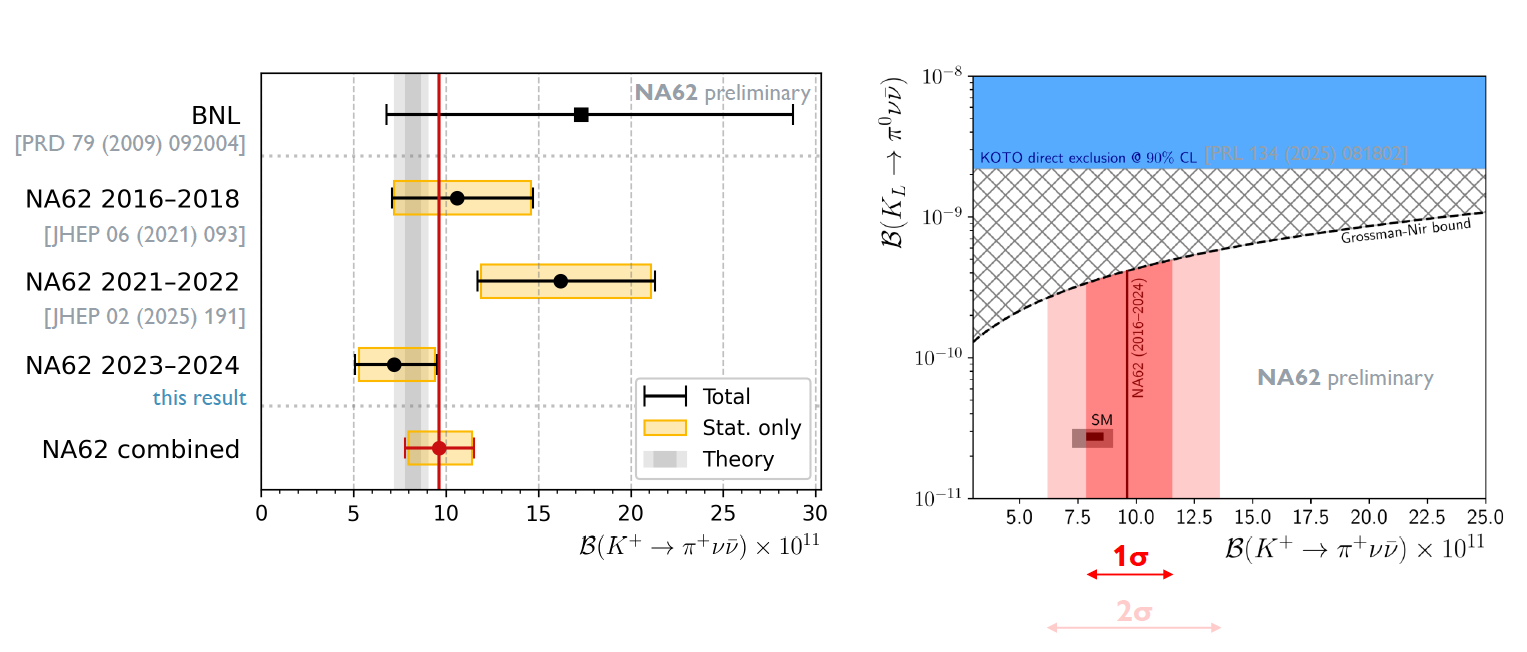
NA62’s updated branching-ratio measurement (red band) refines earlier results and remains consistent with Standard Model predictions, while tightening constraints on possible new physics. Credit: R. Fiorenza, NA62 Collaboration (La Thuile 2026)
Looking ahead
NA62 has now moved decisively from first observation to precision measurement. By incorporating the latest datasets and more powerful analysis tools, the collaboration has brought one of the rarest processes ever studied in the laboratory into significantly sharper focus, with a result that is in excellent agreement with the Standard Model. Further analysis of the 2025 data should improve the precision still more, tightening one of the most demanding tests in flavour physics. In this sense, NA62 continues to show how extraordinary sensitivity can emerge from extraordinary rarity: a decay that happens only once in billions of kaon decays becomes, in the right experimental hands, a powerful microscope on the structure of fundamental physics.
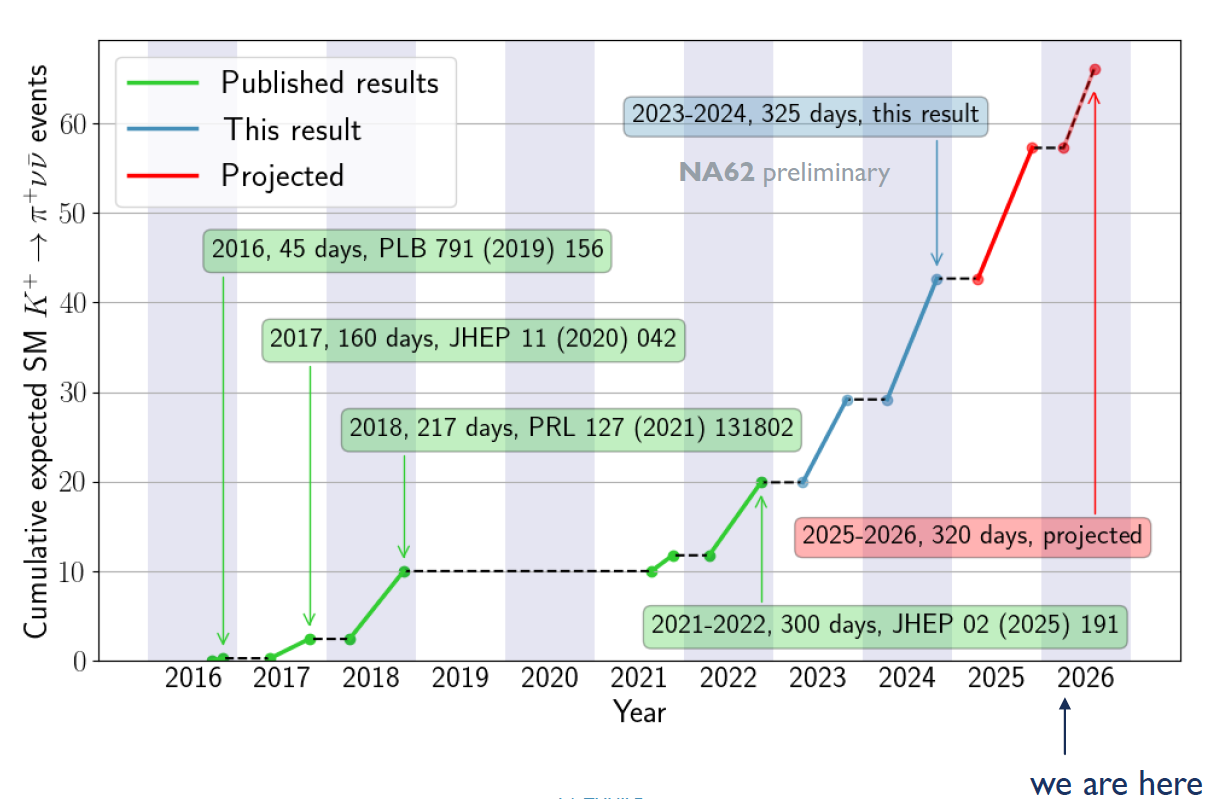
A decade of increasing sensitivity: The cumulative number of expected Standard Model events steadily grows with each NA62 data-taking period, with the 2023–2024 dataset marking a major step toward precision measurements. Credit: R. Fiorenza, NA62 Collaboration (La Thuile 2026)
Note: The author would like to thank Augusto Ceccucci for his thoughtful comments and feedback.


