
CLOUD experiment reveals a major new source of marine aerosol particles
Clouds form when water vapour condenses onto tiny airborne particles known as aerosols. Once these particles grow larger than about 50 nanometres, they can act as cloud condensation nuclei, or CCN, on which cloud droplets form. Increased aerosol particles influence the climate in several ways: they scatter and absorb sunlight, and they make clouds more reflective and more persistent by producing smaller but more numerous droplets. Over the industrial period, emissions have increased aerosol particles and cloud cover, offsetting part of the warming caused by greenhouse gases.
New particle formation takes place in two steps. First, trace vapours in the atmosphere cluster together to form stable particles around 1 nm in size, containing only a few molecules. This process is known as nucleation, and it occurs when the cluster is more likely to continue growing than to evaporate. Second, these embryonic particles must grow rapidly enough to avoid being scavenged by larger pre-existing particles. Only if they reach sizes of around 50 nanometres can they act as cloud condensation nuclei and influence cloud properties. The CLOUD result is important because methanesulphonic acid, or MSA, is ubiquitous in the marine atmosphere and affects both steps: it can nucleate under cool marine conditions, and it grows particles rapidly.
Atmospheric sulphur dioxide emissions from fossil fuels are now declining as a result of air-quality regulations. This is beneficial for human health, but it also means that anthropogenic aerosol particles are expected to decrease later this century, reducing their cooling effect. Understanding natural sources of aerosol particles is therefore essential for reliable climate projections.
The new study, published in Nature by the CLOUD Collaboration, reports the results of experiments performed with dimethyl sulphide, a gas emitted by marine phytoplankton. Dimethyl sulphide is a major natural source of atmospheric sulphur, accounting for around 20% of the total. After oxidation in the atmosphere, it produces both sulphuric acid and methanesulphonic acid (MSA). Sulphuric acid is already known to be a key driver of new particle formation, but the role of MSA has remained uncertain.
“Most climate models currently consider only sulphuric acid-driven nucleation”, explains Jasper Kirkby, spokesperson of the CLOUD Collaboration. “However, it is vital to understand and properly account for biogenic sources to reliably predict the Earth’s future climate and air quality. Observations over the Southern Ocean and in the upper troposphere over the Atlantic and Pacific Oceans indicate that a major source of marine aerosol particles is unaccounted for by current models.”
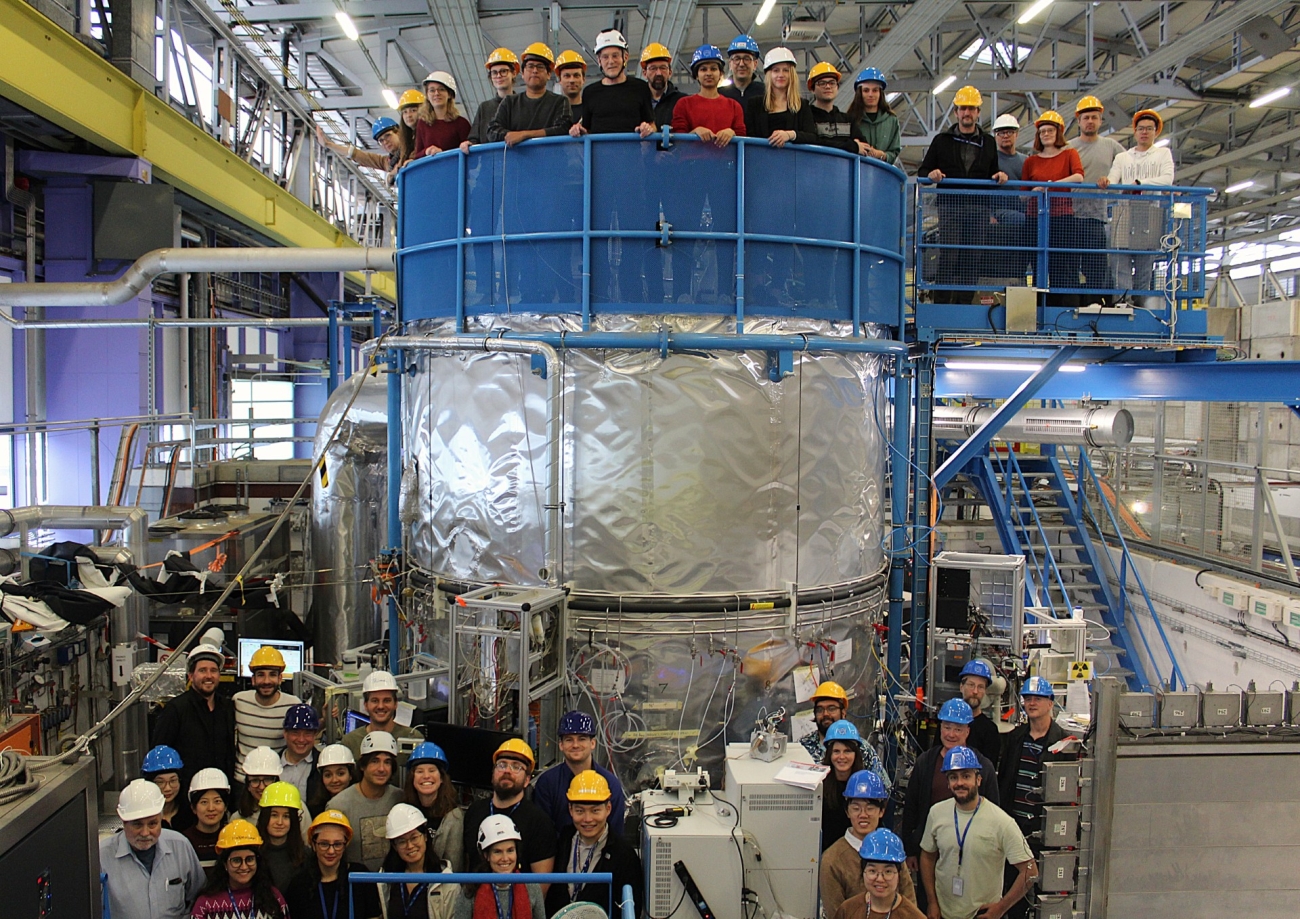
Using the CLOUD chamber at CERN, the collaboration studied how MSA and sulphuric acid contribute to the formation and growth of new particles under controlled atmospheric conditions. The experiments covered temperatures ranging from about +10 °C to −50 °C and included ammonia, a base vapour that helps stabilise embryonic molecular clusters.
The results show that, below about −10 °C and in the presence of ammonia, MSA can participate directly in particle nucleation. In these cold conditions, MSA is found to contribute to new particle formation on a similar basis to sulphuric acid. The two acids can also work together to form mixed molecular clusters that enhance nucleation. At warmer temperatures, around +9 °C, MSA does not appear to drive nucleation under the tested atmospheric conditions, but it still plays an important role in promoting particle growth.
Particle growth is crucial because newly-formed particles are highly mobile and so suffer high losses due to scavenging by pre-existing larger aerosol particles, so they are lost before they become large enough to affect clouds. CLOUD finds that MSA can drive rapid particle growth at cool temperatures, increasing the likelihood that newly formed particles survive to become cloud condensation nuclei.
“Since MSA and SA generally coexist at similar concentrations in cool marine regions, our findings indicate that particle nucleation rates might be accelerated up to tenfold and growth rates up to twofold compared with sulphuric acid and ammonia alone”, adds Jasper Kirkby. “Our model simulations indicate that MSA-driven new particle formation may account for the major missing source of marine aerosol particles in current models.”
The implications are significant for climate modelling. If natural marine emissions produce more CCN than previously assumed, then pristine pre-industrial atmospheres may have contained more biogenic aerosol particles than current models suggest. This could affect estimates of the climate impact of human-made aerosols, as well as projections of warming as sulphur dioxide emissions continue to fall.
The finding also complements earlier CLOUD results showing that isoprene organic vapours from tropical rainforests are driving copious new particle formation in the upper troposphere. Together, these studies suggest that the biosphere may play a larger role than previously thought in sustaining aerosol particles and clouds in clean atmospheric environments.
“The CLOUD Collaboration has made an important advance in our understanding of climate”, says Gautier Hamel de Monchenault, CERN Director for Research and Computing. “It is crucial to deepen our understanding of aerosols: in this case, increased biogenic CCN will affect estimates of the Earth’s climate sensitivity as well as projections of climate warming.”
By revealing the role of methanesulphonic acid in marine particle formation and growth, the CLOUD experiment has identified a natural process that is missing from many current climate models. Including it could help improve predictions of aerosols, clouds and climate in a world moving beyond fossil-fuel sulphur emissions.
Acknowledgement: The CLOUD Collaboration wishes to acknowledge and thank CERN EP-DT, especially the gas and slow control teams, and CERN EN-MME for their crucial contributions to the CLOUD experiment. In particular, the collaboration thanks Pascale Blanc, Mattia Busato, Louis-Philippe De Menezes, Roberto Guida, Ilia Krasin, Robert Kristic, Didier Lombard, Giulio Malaguti, Serge Mathot, Pierre Minginette, Xavier Pons and Sylvain Ravat. The collaboration also thanks Aboubakr Ebn Rahmoun, Martin Jaekel, Michael Lazzaroni, Laurence Nevay and the CERN PS machine team for their support of CLOUD.
Note: The author would like to thank Jasper Kirkby, CLOUD spokesperson, for his careful reading of the article and for his valuable comments and suggestions on the final version.


