
ISOLDE
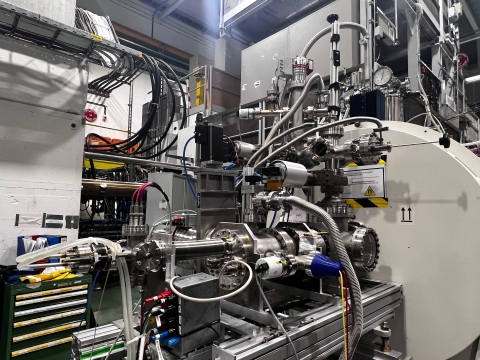
Probing lithium dynamics at buried interfaces with β-detected NMR at ISOLDE
Spin-polarised probes have been central to nuclear and particle physics since the discovery of parity violation by Chien-Shiung Wu in 1956, who detected asymmetric emission of β-radiation from low-temperature 60Co in a magnetic field. The…
Read more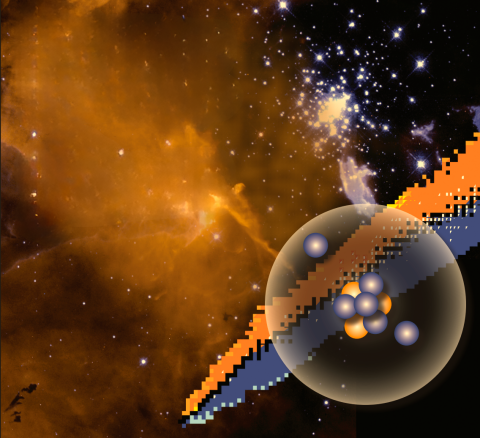
Decoding r-Process Nucleosynthesis: Precision Studies of Exotic Indium Isotopes at ISOLDE
How are the chemical elements synthesised in stellar environments? Which processes lead to their creation? What impact does nuclear physics have on their production? Describing the origins of the chemical elements and their observed…
Read more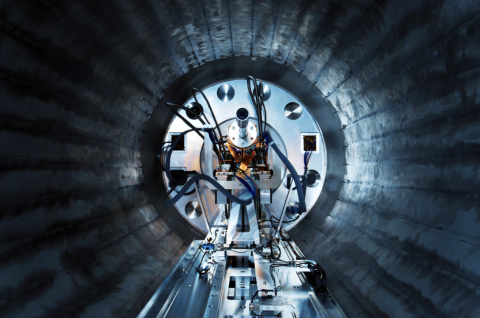
Updates from the ISOLDE Solenoidal Spectrometer
The field of nuclear physics is well into its second century. From its initial experiment bombarding a gold foil with alpha particles, experimental techniques have become more sophisticated to keep pace with the technology and innovation that has…
Read more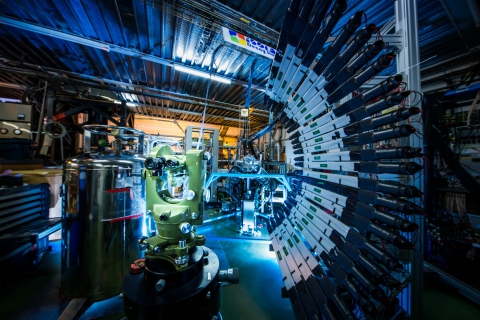
Perturbed angular correlations at ISOLDE
Solid state physics and biophysics research has been conducted at ISOLDE-CERN for almost 50 years [JOH2017]. Our role in supporting experimental equipment and manpower has enabled the development of on-site laboratories. This has several advantages…
Read more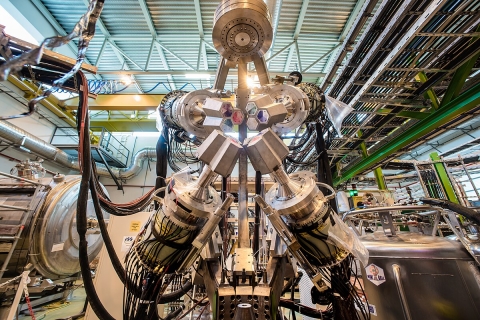
Investigating exotic structures of exotic nuclei with Miniball
Atomic nuclei come in all manner of shapes and sizes, sometimes at the same time! The reason behind this diversity lies in poorly understood nuclear forces. Many features of these forces only came to light when studying very unstable nuclei, which…
Read more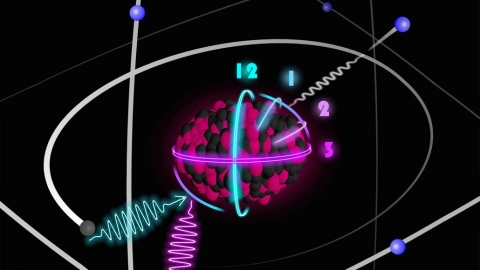
Radioactive ion beams at ISOLDE bring the nuclear clock a tick closer
The precise measurement of time and frequencies has always played an important role in the history of science. Since the adoption of the caesium-133 standard as the definition of the second within the Système International (SI) in 1967, a network of…
Read more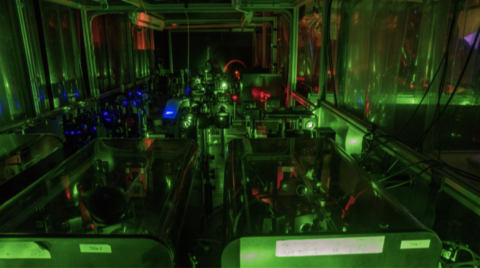
The LISA project at CERN-ISOLDE
The LISA (Laser Ionisation and Spectroscopy of Actinides) consortium aims to train a new generation of experts in radioactive ion beam research and applications, laser spectroscopy, scientific laser…
Read more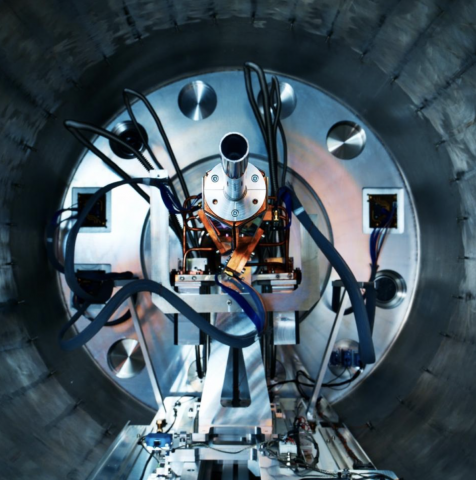
ISOLDE's Solenoidal Spectrometer (ISS): a new tool for studying exotic nuclei
The majority of atomic nuclei exist away from the valley of beta-stability, so it is perhaps unsurprising that in studying them nuclear physicists have discovered emerging phenomena not seen in stable nuclei. Changing shell structure, evolving…
Read more
The many faces of ISOLDE
You will stand across the street from the ISOLDE facility, when visiting CERN’s medical center, fire fighters, raw materials store, transport teams, or goods reception service. Located centrally at the Meyrin site (https://videos.cern.ch/record/…
Read more
ISOLDE determines precise nuclear moments by devising novel experimental technique
Nuclear quadrupole moments (Q), a measure of charge asymmetry in nuclei, are experimentally accessible via the quadrupole interaction frequency νQ=eQVzz/h. To extract Q from this information one needs to know Vzz, the electric-field gradient at the…
Read more