
A word from the EP Department Deputy Head - Summer 2026
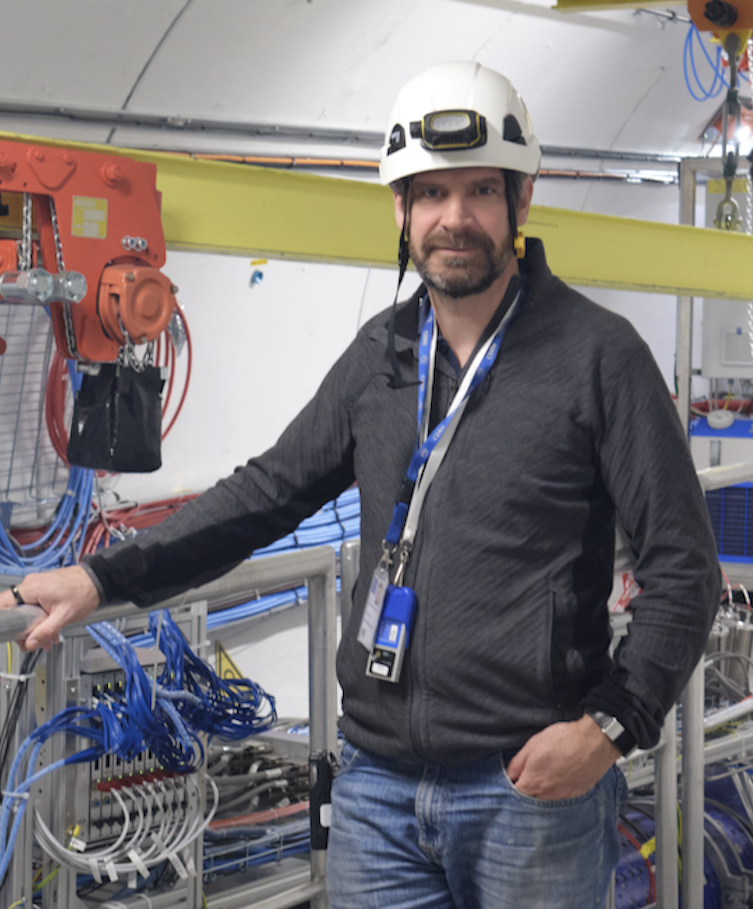
I am very happy to introduce the summer 2026 edition of the EP newsletter.
Firstly, allow me to briefly introduce myself. I have started as the deputy department head of EP at the beginning of this year. Before that I have been a long-standing research physicist on the ATLAS experiment, and more recently I have been co-leading the FASER experiment at the LHC. I also had the chance to act as the LHC Programme Coordinator for 20216-17, which broadened my knowledge of CERN, and allowed me to get to know colleagues in the accelerator sector. I am looking forward to working with you all in my new role in the EP department management.
As I write this the LHC has just finished its physics programme for Run 3, with excellent performance from the accelerator and experiments. Long Shutdown 3 (LS3) formally starts for the LHC at the end of June while for some of the other facilities the shutdown will start in September. LS3 will be an extremely busy and challenging period, with many experiments installing cutting-edge detector upgrades to enable impressive physics gains in Run 4. As we enter the summer period, and the heat starts to rise(!), I hope you all can take advantage of the period to take some time off and enjoy a well deserved holiday.
In this issue we have many interesting articles highlighting the extremely broad set of activities pursued within the EP department at CERN. From articles on detector R&D, including a nice summary of the recent EP R&D day, Data Quality monitoring, an update on the Rucio data management tool, and an article highlighting synergies between the use of AI in HEP and gravitational wave research. The issue also features summaries of recent physics highlights covering Higgs, SUSY, hadron spectroscopy, and neutrinos as well as news and updates from the AD and ISOLDE.
In addition, we have a dedicated set of articles focusing on first results from the light-ion run that took place at the LHC last year. This dataset is already proving to be a treasure trove of physics with the discussed results providing important input for studying the quark gluon plasma in smaller collision systems, and the effect of the initial shape of the colliding nuclei on such measurements, as well as providing crucial input for cosmic-ray physics.
Moreover, this issue includes a very interesting interview with John Ellis on the eve of his 80th birthday, providing a historical perspective on several decisive moments in particle physics over the last decades and wise words for the future. I hope that people will have a chance to dive into some of these articles over the summer period.
Happy reading!


