
ATLAS Turns Into a Precision Cosmic Ray Laboratory
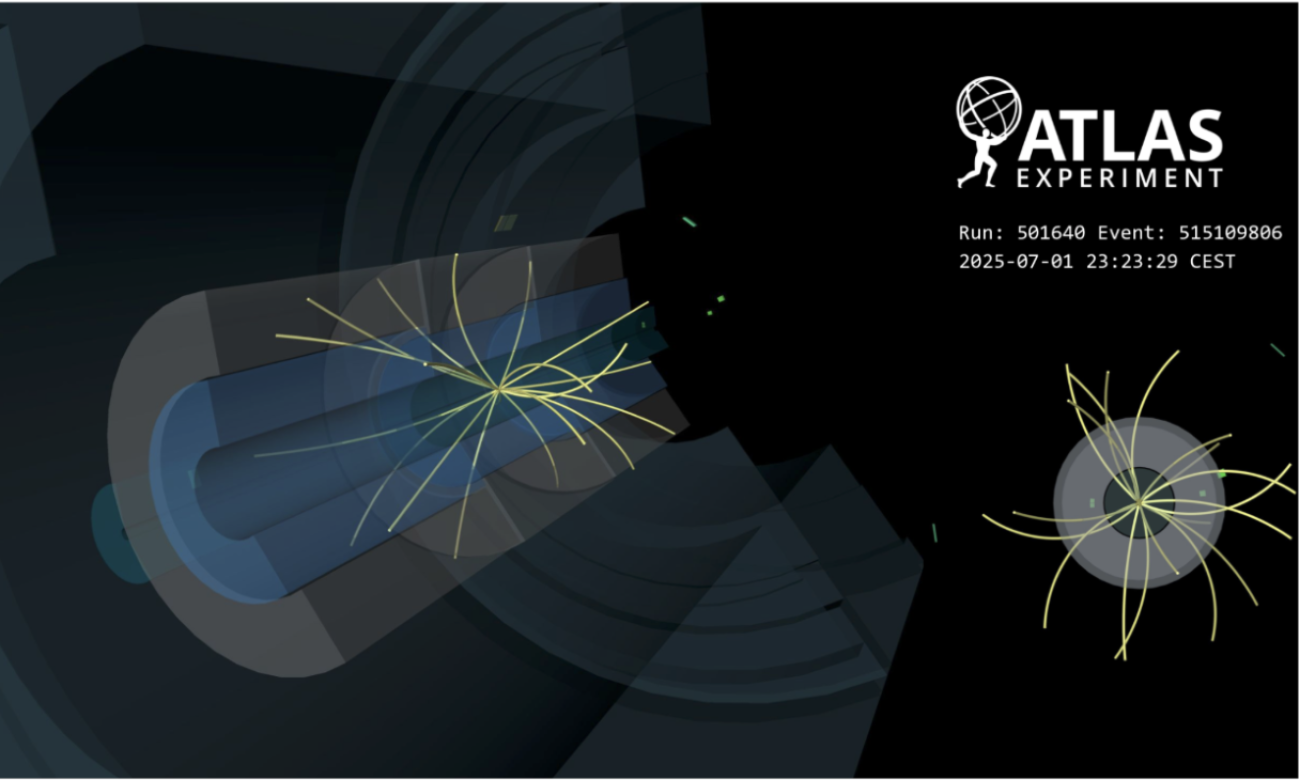
Event display of a proton-oxygen collision recorded in ATLAS Run 501640 on 1st July 2025 at 23:23:29 CEST. The event contains 19 reconstructed tracks (yellow lines) satisfying pT > 500 MeV with at least one Pixel hit and at least six SCT hits.
Every second, roughly one charged particle produced by a cosmic-ray air shower passes through your body. These showers begin tens of kilometres above Earth’s surface, when high-energy particles from outer space slam into atmospheric nuclei, primarily of oxygen and nitrogen. Despite a century of study since Victor Hess first detected cosmic rays aboard a hot-air balloon in 1912, the hadronic physics driving these showers remains poorly understood. The Monte Carlo (MC) event generators used to interpret data from ground-based cosmic ray observatories such as Pierre Auger, Telescope Array, and IceCube disagree with one another at the level of tens of per cent, limiting sensitivity to the primary energy and composition of the incoming cosmic radiation and its mysterious origins.
The missing ingredient is high-precision, accelerator-based data on proton-atmosphere interactions at the relevant energies. In July 2025, the LHC provided exactly that, colliding protons against an oxygen-ion beam at a nucleon-nucleon centre-of-mass energy of √sNN = 9.62 TeV. The asymmetric beam arrangement mimics, in the laboratory frame, a cosmic-ray proton striking an oxygen nucleus at rest in the stratosphere at an equivalent energy of about 49 PeV, squarely in the energy range that ground-based observatories are sensitive to.
The ATLAS analysis targets the non-diffractive production topology, selecting 246 million events and 5.11 billion reconstructed charged-particle tracks in the pT > 500 MeV, |η| < 2.5 phase space.
Three basic observables are corrected to particle level: the charged-particle multiplicity distribution, the pseudorapidity spectrum of the charged particles, as well as their transverse momentum spectrum. Systematic uncertainties are controlled at the few-per cent level, depending on the phase-space region, and are dominated by our imprecise knowledge of the passive material distribution in the inner detector. This simple analysis strategy was aimed at delivering a fast result to support a prompt feedback loop between theorists and experimentalists.
The results summarised in Figure 1 expose striking differences among the predictions of the MC generators most widely used in comparison to cosmic-ray and heavy ion collision data: HIJING, EPOS LHC-R, QGSJET III, Sibyll 2.3e, and PYTHIA 8 Angantyr. These models were all tuned to existing proton-proton and proton-lead data, yet they extrapolate differently to the new proton-oxygen phase space, and disagree with one another by amounts well exceeding the ATLAS measurement uncertainties of a few per cent. No single generator provides a uniformly good description across all three observables.
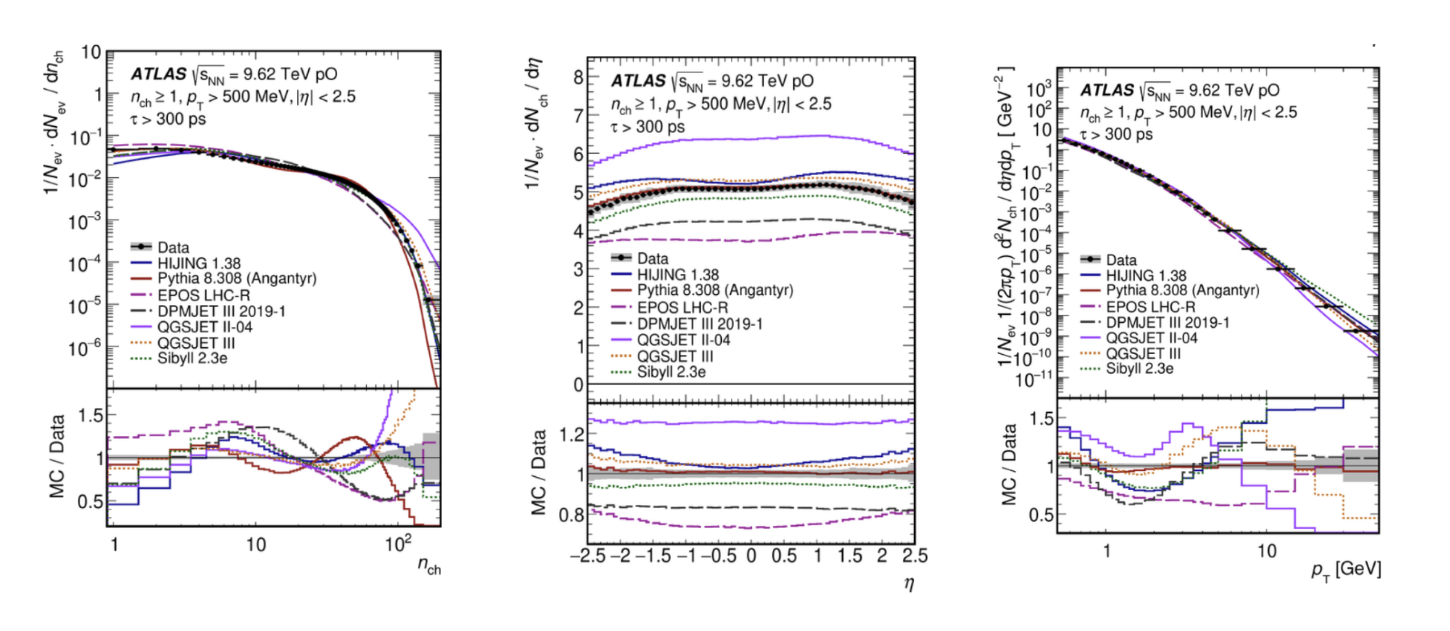
Figure 1. Distributions of (a) primary charged-particle multiplicity, (b) primary charged-particle pseudorapidity, and (c) primary charged-particle transverse momentum, in the fiducial acceptance. Data are shown as black points, with the shaded band showing the total uncertainty, while the coloured lines show the different Monte Carlo event generator predictions indicated in the legend.
The charged-particle density in pseudorapidity shows that the models bracket the data at mid-rapidity, with shape discrepancies growing toward the forward regions. Here Angantyr describes the data within the uncertainties, while QGSJET III and Sibyll 2.3e are within about two standard deviations across the entire range. The pT spectrum discriminates sharply among the models at low transverse momenta, where non-perturbative soft QCD processes such as diffraction, multi-parton interactions, and the details of hadronisation are important. Similarly, different shapes are predicted for the charged-particle multiplicity distribution, with discrepancies of up to 50% over much of the range and up to an order of magnitude at the highest multiplicities.
The corrected number of events within the ATLAS acceptance can be converted into a measurement of the fiducial proton-oxygen cross-section of 396 ± 6 (exp.) ± 9 (lumi.) mb. The MC models are used to extrapolate this measurement to the full phase space, and further to proton-air collisions, assuming that air is 78% nitrogen and 22% oxygen, yielding a total proton-air cross-section of 406 ± 6 (exp.) ± 9 (lumi.) ± 28 (theory) mb. This extrapolation is dominated by the theoretical uncertainty arising from the modelling of the diffractive contribution that is lost from the ATLAS acceptance, and by our lack of knowledge of the geometry profiles of the colliding nucleons. The measurement is shown in comparison to other ground-based observations and MC models in Figure 2, and is broadly consistent with expectations.
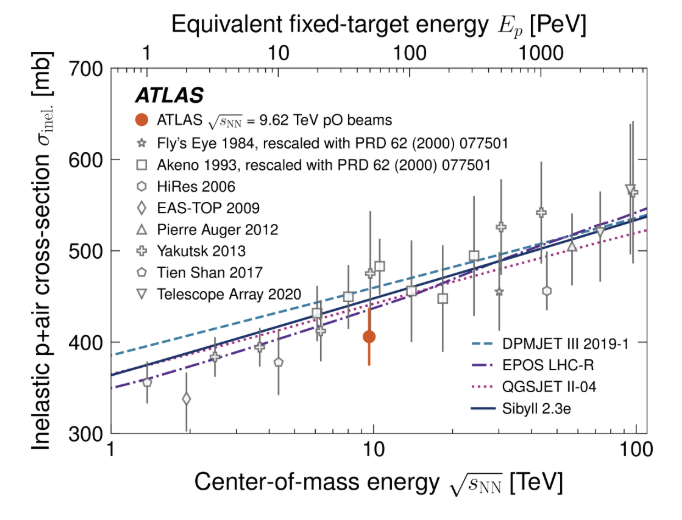
Figure 2. The extrapolated proton-air cross-section (filled orange marker) shown in comparison to observatory results (empty markers) and model predictions (solid lines) as a function of nucleon-nucleon centre-of-mass energy on the bottom axis and the equivalent fixed-target energy on the top axis.
On the experimental side, the ATLAS cosmic-ray programme is merely beginning. In May, the ATLAS Collaboration hosted an open workshop on potential future measurements using the same rich dataset. The measurement could be improved by lowering the track pT requirement and measuring the kinematic spectra differentially as a function of multiplicity. Requiring a neutron tag in the ZDC or LHCf detectors could constrain the pion-oxygen subprocess, a leading source of uncertainty, while requiring a forward proton tag in the ATLAS forward proton spectrometer (AFP) could help to constrain nuclear PDFs. Since AFP was also included on the oxygen side of the collision during this special run, it may be possible to detect oxygen-ion fragments in the forward region, offering a unique opportunity to study heavy-ion fragmentation.
As Run 3 draws to a close, the ATLAS proton-oxygen measurement stands as a compelling illustration of how the LHC – primarily a machine for TeV-scale particle physics – can also act as a laboratory for astrophysics, placing collider precision at the service of some of the oldest open questions about the high-energy universe.
Further Reading
[1] ATLAS Collaboration, Measurement of charged-particle production in √sNN = 9.62 TeV proton-oxygen collisions as a probe of cosmic-ray air showers with the ATLAS detector, STDM-2025-08, arXiv:2604.05512 [hep-ex]
[2] Ynyr Harris, SM@LHC 2026 conference presentation. Available at: https://agenda.infn.it/event/48435/contributions/287691/
[3] “Mini-Workshop on Proton-Oxygen Next Steps” (Online), 11 May 2026, CERN Indico event 1674975. Available at: https://indico.cern.ch/event/1674975


