
AI for Gravitational Waves: Building Bridges Between Scientific Communities
As gravitational-wave observatories enter a new phase of sensitivity, scale and scientific ambition, the challenge is no longer only to detect faint ripples in spacetime. It is also to analyse, interpret and respond to them fast enough to open new windows on the Universe.
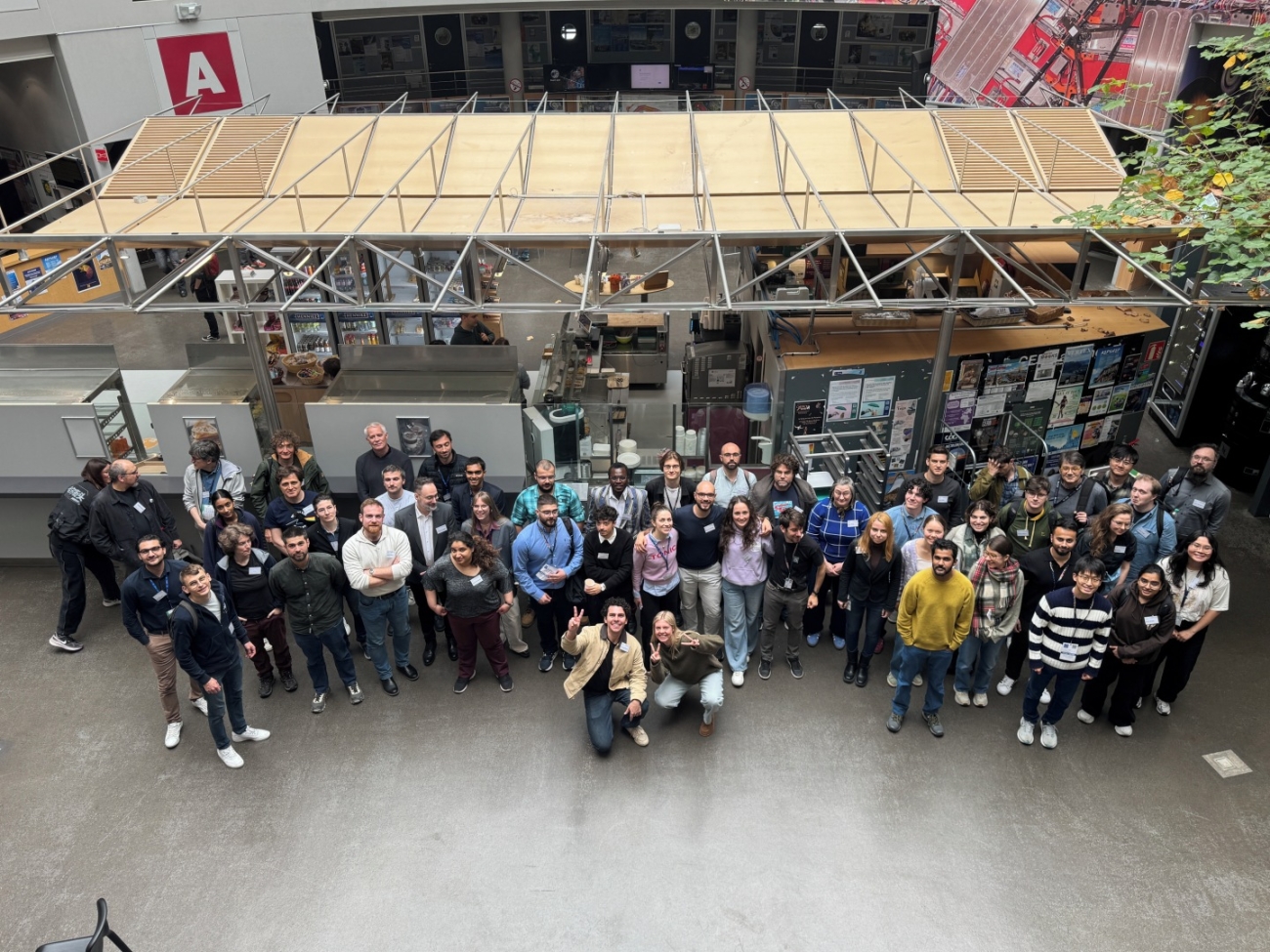
This was one of the motivations behind the AI for Gravitational Waves Workshop, held at CERN from 5 to 8 May 2026. The meeting brought together researchers working on gravitational-wave science with expertise in artificial intelligence, real-time data processing, detector operations and computing. Its aim was both focused and ambitious: to explore how AI can help gravitational-wave science address the challenges of the coming decade while opening a dialogue with the LHC AI community, which has long grappled with related questions.
The workshop was conceived as a bridge between CERN and the gravitational-wave community. Individual connections between the two communities already exist, and cross-fertilisation between collider physics and gravitational-wave science is already taking place at different levels. The aim of the meeting was to create the conditions for a more sustained exchange and perhaps to lay the foundations for something more structured in the future.
Beyond the specific scientific goals of gravitational-wave astronomy, the workshop highlighted a broader trend emerging across many areas of fundamental science. Artificial intelligence is increasingly becoming a universal scientific toolbox. Techniques such as classification, regression, denoising, anomaly detection and simulation acceleration are now finding applications across disciplines that historically evolved independently. Although particle colliders and gravitational-wave interferometers probe very different physical phenomena, they face remarkably similar computational and operational challenges. At the workshop, participants had the opportunity to reflect on how methods developed in one domain can often be transferred to another, creating opportunities for scientific progress that extend beyond the boundaries of individual disciplines.
The timing could hardly be better. Gravitational-wave astronomy is preparing for richer data streams, more frequent detections and increasingly complex inference problems. The Einstein Telescope and other third-generation ground-based detectors will push the field towards new regimes of sensitivity, while LISA will open a low-frequency gravitational-wave window from space. At the same time, AI and machine-learning techniques are rapidly moving from exploratory studies to operational tools that support data analysis, simulation, detector monitoring, and real-time decision-making.
For CERN’s Experimental Physics community, these questions are immediately familiar. The LHC experiments operate in an environment where enormous amounts of information are produced every second, while only a tiny fraction can be stored for later analysis. Decisions have to be made rapidly, reliably and close to the detector. Trigger and data acquisition systems must identify potentially interesting events within strict time and computing constraints. With the High-Luminosity LHC and future facilities, these demands will only grow.
This is one of the areas where AI has already made a significant impact in high-energy physics. AI was presented during the workshop not simply as a way to improve performance, but as a way to make complex workflows fast enough to be useful under real experimental conditions. In many cases, physicists know how to translate detector data into the answers they seek, but the process requires substantial domain knowledge and considerable computing resources. Neural networks can offer efficient approximations of demanding reconstruction, classification, regression and inference tasks, enabling analyses that would otherwise be impractical at scale.
The workshop programme reflected this convergence. Sessions covered AI for gravitational-wave detection, classification and parameter estimation, probabilistic machine learning, simulation-based inference, normalising flows, and Gaussian processes. Other contributions explored self-supervised learning, surrogate models, fast simulation and uncertainty-aware inference. These topics resonate strongly with developments in high-energy physics, where machine learning is increasingly central to event reconstruction, detector simulation and physics analysis.

A second major theme was real-time data processing. This is perhaps where the connection with CERN is most direct. The LHC trigger problem has long forced physicists to ask how rare or unexpected signals can be recognised before most of the data is discarded. At the LHC, collisions occur at a rate of 40 million per second. Trigger systems must reduce this enormous data flow almost immediately, long before all events can be written to permanent storage.
For gravitational-wave astronomy, the same challenge appears in a different form. Low-latency detection and inference can determine whether telescopes and other observatories can follow up on a candidate event in time to capture the full multi-messenger picture. In this context, speed, robustness and trust in the analysis pipeline become part of the scientific discovery process itself.
This is where CERN’s experience with fast, on-edge AI becomes especially relevant. The workshop highlighted developments within the Next Generation Triggers project and the deployment of neural networks on specialised hardware, such as FPGAs. Tools such as hls4ml, which translate machine-learning models into low-latency firmware implementations, demonstrate how AI can be brought close to the detector and executed under strict timing constraints.
The Next Generation Trigger project represents a particularly ambitious step in this direction. By combining modern machine-learning techniques with heterogeneous computing architectures, including FPGAs and specialised accelerators, NGT aims to rethink how future LHC experiments process information in real time. Rather than simply improving existing trigger systems, the project explores how intelligent inference can become an integral part of the data-acquisition chain, enabling entirely new approaches to event selection, anomaly detection and data reduction. While motivated by the challenges of the High-Luminosity LHC, many of the concepts being developed are also relevant to next-generation gravitational-wave observatories and other large-scale scientific facilities facing similar constraints on latency, bandwidth and computing resources.
Detector operations provided another natural point of contact. Modern scientific facilities are among the most complex instruments ever built, generating vast streams of operational data that must be monitored continuously to ensure stable and efficient performance. In both collider experiments and gravitational-wave observatories, AI is increasingly being explored as a tool for infrastructure monitoring, predictive maintenance, data-quality assessment and anomaly detection. While the underlying hardware differs substantially, many of the methodological challenges are shared. The ability to identify unusual behaviour before it affects scientific performance is becoming as important as the ability to analyse the data itself.
The theme of anomaly detection provided another strong bridge between the two communities. In collider physics, anomaly detection has emerged as a promising approach to remain sensitive to unexpected signatures that do not fit predefined search categories. In gravitational-wave science, related approaches can help identify unusual signals, glitches or entirely new classes of events within complex time-series data. In both fields, AI offers the possibility of moving beyond searches that only look for what is already anticipated.
The workshop also included a dedicated CERN-facing session on infrastructure and operations, covering AI on edge, underground and in space, agentic AI for infrastructure control, CERN’s evolving AI infrastructure and developments associated with the Next Generation Trigger project. These discussions highlighted that successful AI adoption requires much more than algorithms. Reproducible workflows, scalable computing resources, monitoring, deployment tools and long-term software sustainability are becoming essential components of modern scientific research.
For the EP community, this is a familiar lesson. A physics result depends not only on a clever algorithm, but also on the reliability of the surrounding ecosystem: software, computing, detector operations, calibration and data-quality monitoring. As AI systems move closer to real-time use, questions of deployment, validation, monitoring and maintainability become just as important as raw performance.
As CERN develops its long-term strategy for artificial intelligence, initiatives such as the AI for Gravitational Waves workshop provide an important opportunity to build bridges across scientific communities. CERN can play a role that extends beyond being a user of AI technologies. By bringing together communities facing similar challenges, providing shared infrastructure and fostering cross-disciplinary collaborations, the laboratory can help accelerate innovation across multiple scientific domains. The AI for Gravitational Waves workshop offered a glimpse of this future: one in which advances developed for particle collisions, gravitational-wave interferometers and other frontier instruments reinforce one another, enabling discoveries that no single community could achieve alone.
At its heart, the workshop was about more than algorithms. It was about preparing scientific communities for a future in which discovery may depend on the ability to listen, decide and respond in real time. Whether the signal comes from a particle collision at the LHC, a noise transient in an interferometer or the inspiral of compact objects across the cosmos, the challenge is increasingly the same: to recognise the rare event, preserve the information that matters and turn data into understanding.
As the opening remarks suggested, this meeting may become the seed for something larger. For CERN and the gravitational-wave community, that seed lies in a shared recognition: the next generation of discoveries will require not only new instruments but also new forms of collaboration among physics, computing, and artificial intelligence.


