
Light ions bring CMS closer to the onset of QGP-like behaviour
What are the smallest droplets of strongly interacting matter that exhibit colour deconfinement? This question has become one of the most intriguing frontiers in heavy-ion physics. At very high temperatures and densities, quantum chromodynamics predicts that quarks and gluons are no longer confined inside individual hadrons, but form a colour deconfined state of matter known as the quark–gluon plasma. Since the start of the LHC heavy-ion programme in 2010, collisions of large nuclei such as lead and xenon have provided compelling evidence that such matter is produced and that it behaves like a nearly perfect fluid.
Yet this success immediately raises a more subtle question. How does the transition happen between ordinary hadronic matter, where no extended medium is expected, and the strongly interacting fluid observed in large heavy-ion collisions? What are the minimal conditions required for QGP to emerge? Several QGP-like behaviours have been observed in proton–nucleus and even proton–proton collisions, while whether a QGP is actually produced in these systems remains an open question. Recent oxygen–oxygen and neon–neon collisions at the LHC gave CMS a new way to explore this transition.
Light ions occupy a special place in this search. They are much smaller than lead or xenon nuclei, but unlike proton–nucleus collisions they provide larger transverse and more symmetric collision geometries. This makes OO and NeNe collisions an ideal bridge between small systems such as pp and pPb, and the large heavy-ion systems in which QGP formation is well established. By studying them, CMS can ask whether the signatures associated with a strongly interacting medium persist when the system size is dramatically reduced.
The first step is to understand how dense these collisions are. CMS measured the charged-particle multiplicity in OO collisions at 5.36 TeV as a function of pseudorapidity. Around midrapidity, the data show roughly 40 charged hadrons per unit pseudorapidity in non-single diffractive events. This is about seven times more than in pp collisions, but around fifteen times less than in PbPb collisions. In other words, light ions do not create an environment as dense as conventional heavy-ion collisions. This makes any sign of medium-like behaviour particularly revealing.
A direct comparison with PbPb is not enough, however, because lead ions simply contain many more nucleons than oxygen ions. CMS therefore also studies the charged-particle multiplicity, normalised by the number of participating nucleons, in events classified by their overlap-geometry size. With this scaling, the most central (head-on) OO collisions reach values similar to those observed in larger heavy-ion systems, and significantly higher than pp collisions. This suggests that central OO collisions convert unit collision energy into entropy with an efficiency comparable to that of heavy ions and higher than that of pp collisions, indicating that OO collisions are not simple independent superpositions of nucleon-nucleon interactions.
This observation is suggestive but not conclusive by itself. It does, however, motivate the comparison with hydrodynamic models. If a fluid-like medium is formed, hydrodynamics should describe how it expands and how the initial collision geometry is translated into final-state observables. Remarkably, hydrodynamic calculations tuned to heavy-ion data describe the centrality dependence of the OO charged-particle multiplicity at midrapidity when extrapolated to this much smaller system. This is one of the first indications that light-ion collisions may already contain some of the ingredients associated with collective medium dynamics.
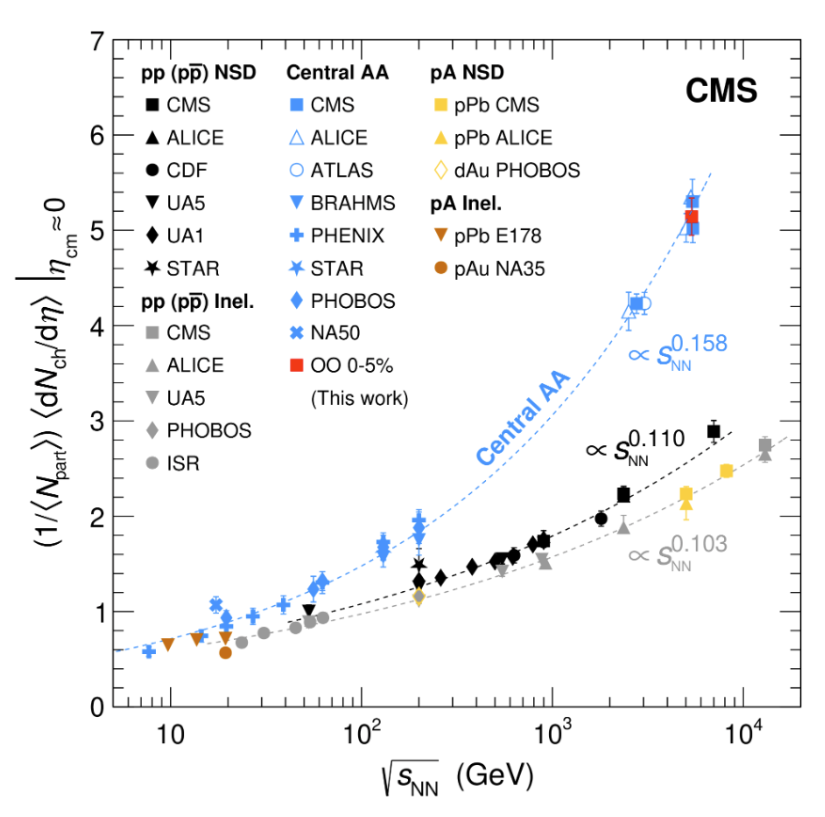
Figure 1: CMS explores particle production by examining the dependence of charged particle production normalised by the number of participating nucleons on the collision energy for various collision systems. The particle production in central OO collisions is found to follow the same enhanced scaling observed in heavier-ion systems, supporting the presence of collective dynamics beyond independent nucleon-nucleon interactions.
A more direct signature comes from anisotropic flow. When two ions collide with a non-zero impact parameter, the overlap region is not circular but almond-shaped. If no medium is produced and particles simply stream out independently, this initial spatial anisotropy should largely be washed out. If, however, a collectively expanding medium is formed, pressure gradients convert the initial geometric anisotropy into an anisotropy in the momenta of the final-state particles. This effect is quantified using the Fourier coefficients of the azimuthal particle distribution, in particular the elliptic-flow coefficient v2.
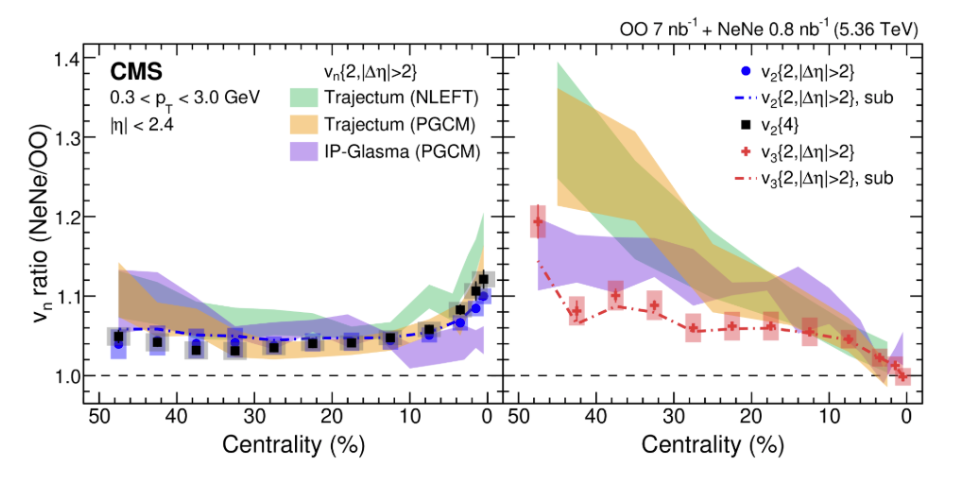
Figure 2: CMS measures azimuthal anisotropy in OO and NeNe collisions, observing a significant positive v2, indicative of collective motion in light-ion collisions. The slight increase of the ratio of v2 in NeNe to v2 in OO in the most central collisions is predicted by hydrodynamic models due to the deformed Ne nuclear shape.
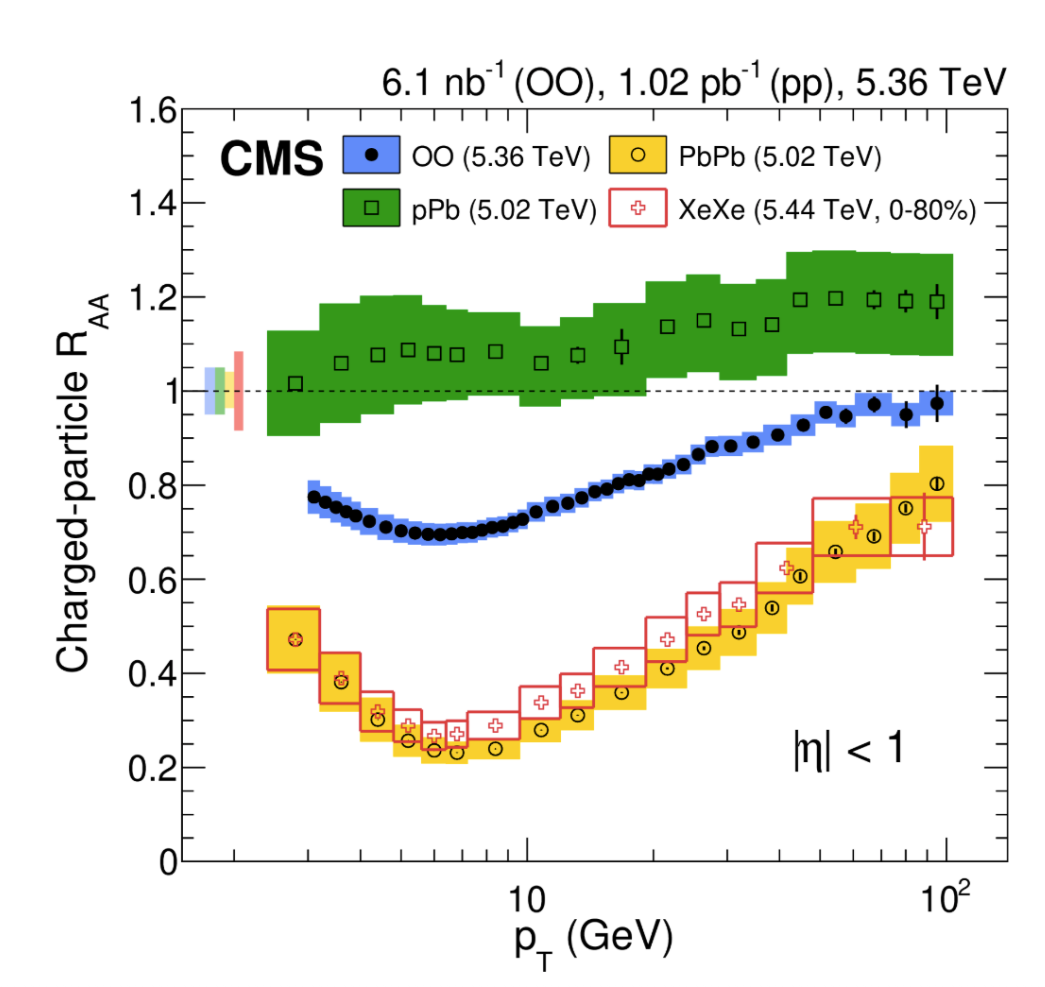
Figure 3: CMS observes a clear suppression of charged particles in oxygen–oxygen collisions at 5.36 TeV. The nuclear modification factor, RAA, is more than five standard deviations below unity near its minimum and is measured up to transverse momenta of 100 GeV/c. This makes OO the smallest collision system so far in which such suppression has been observed.
CMS observes a significant nonzero v2 in oxygen–oxygen collisions, providing evidence of collective motion. Its centrality dependence follows the qualitative expectation from hydrodynamics. Moving from the most central to semi-central collisions, v2 increases as the initial geometry becomes more anisotropic. Towards more peripheral collisions, v2 decreases again, consistent with the produced medium becoming more dilute and more viscous. The measurements are described well by hydrodynamic predictions, and similar behaviour is observed in NeNe collisions.
The comparison between OO and NeNe reveals an even more subtle effect. Oxygen and neon have comparable sizes, but CMS observes that the ratio of v2 in NeNe to v2 in OO increases in the most central collisions. In such nearly head-on collisions, the measurement becomes especially sensitive to the nucleus's intrinsic shape. Hydrodynamic calculations predict that a deformed, “bowling-pin-like” neon nucleus would enhance this ratio. By comparing NeNe directly with OO, many uncertainties related to the subsequent medium evolution largely cancel, leaving a cleaner sensitivity to initial nuclear geometry.
This opens an intriguing possibility: high-energy ion collisions at the LHC may provide information not only about hot QCD matter, but also about the shape and structure of the colliding nuclei themselves. At the same time, the interpretation needs to remain cautious. The NeNe-to-OO flow ratio is sensitive to nuclear geometry as transferred to final-state momentum space, but it does not by itself separate all possible contributions from nuclear deformation, clustering or other structural effects. Further work with nuclear-structure and heavy-ion theory will be needed to fully exploit this new handle.
Collective flow was one of the first QGP-like phenomena observed in high-multiplicity pPb and pp collisions, whereas parton energy loss is a phenomenon that has been unambiguously established only in heavy-ion collisions. In heavy-ion collisions, energetic quarks and gluons lose energy while traversing the quark–gluon plasma, leading to a suppression of high-transverse-momentum particles. CMS studies this using the nuclear modification factor, RAA, which compares charged-particle production in ion–ion collisions with a pp reference, after normalising for the expected number of binary nucleon–nucleon collisions. If an ion–ion collision behaved simply as a superposition of independent nucleon–nucleon interactions, RAA would be close to one. This is approximately the case in pPb collisions. In PbPb and XeXe collisions, by contrast, RAA is significantly below one.
Before the OO measurement, there was no common expectation for how large the suppression would be in such a small ion–ion system. Theoretical expectations ranged widely, reflecting uncertainty over whether oxygen–oxygen collisions could produce significant final-state medium effects. CMS now observes a clear charged-particle suppression in OO collisions over a broad transverse-momentum range, from about 3 to 100 GeV/c. Around pT ≈ 6 GeV/c, the deviation of RAA from unity reaches about seven standard deviations. This makes oxygen–oxygen the smallest collision system so far in which such suppression has been observed.
This result is a key piece of information in the search for the onset of QGP, but its interpretation requires care. Suppression in RAA does not automatically imply final-state energy loss in a hot medium. Other effects can also modify particle production. Among the most relevant are nuclear parton distribution functions, which describe how the partonic structure of a nucleon bound inside a nucleus differs from that of a free proton.
CMS comparisons show that nPDF effects alone can contribute significantly to the observed suppression in OO collisions, but they are not sufficient to fully account for it. When parton energy loss is included in the models, the agreement with the data improves. This suggests that energy loss is likely required to account for the strong suppression, while also underscoring the need for a precise baseline.
The proton–oxygen data collected at the LHC will be crucial in this respect. They will help constrain the nPDF uncertainties for oxygen and provide a better reference for what should be expected without final-state energy loss. Such a baseline is essential before stronger conclusions can be drawn about the origin of the suppression observed in OO collisions.
The NeNe measurement adds another important handle. CMS observes a hint of stronger suppression in NeNe than in OO at lower transverse momentum, while the two systems tend to converge at higher pT. Since nPDF effects should be similar in oxygen and neon, differences between the two systems may be more directly sensitive to energy-loss effects. However, this comparison probes small differences, and global uncertainties remain important. These are currently dominated by the luminosity determination, based on a preliminary van der Meer scan analysis cross-checked with Z-counting. A full van der Meer scan analysis is ongoing and is expected to reduce these uncertainties further.
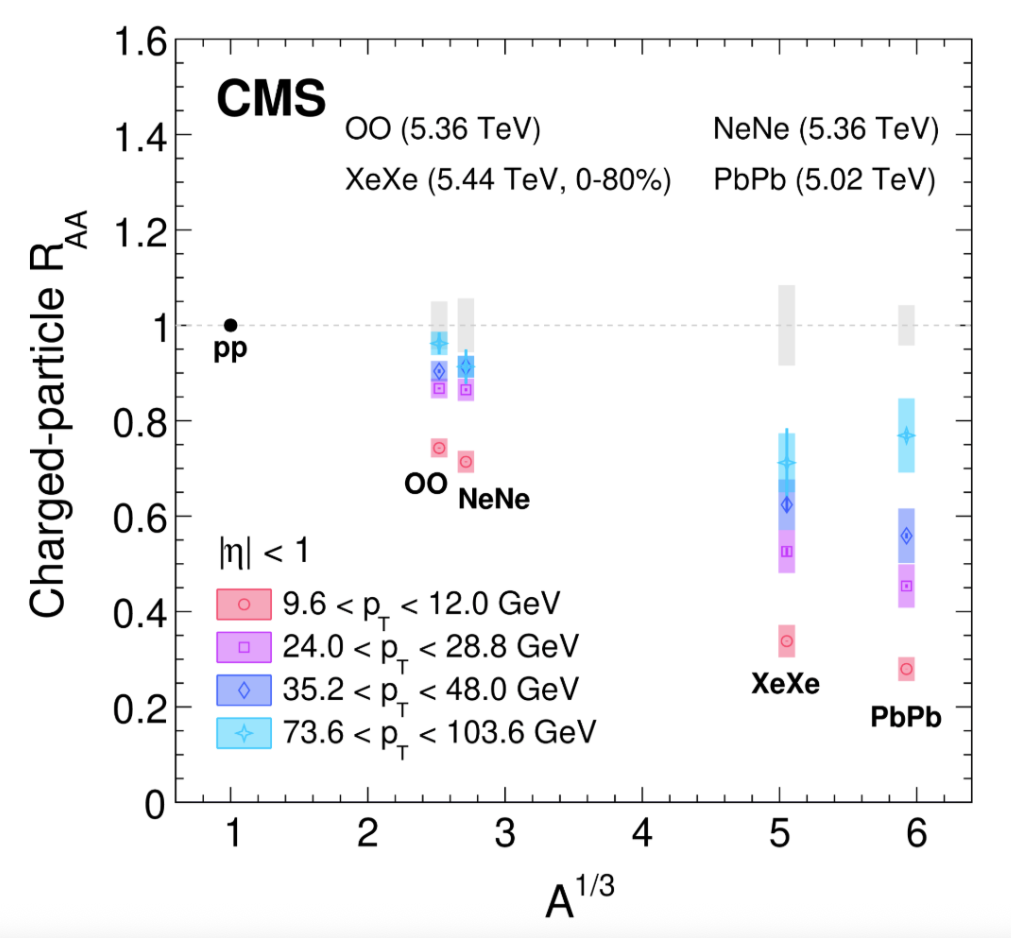
Figure 4: CMS compares the charged-particle nuclear modification factor, RAA, in oxygen–oxygen,neon–neon, xenon–xenon and lead–lead collisions, showing an increasing suppression with the nucleon number A. Since nuclear PDF effects are expected to be similar in OO and NeNe, the observed difference offers a cleaner sensitivity to parton energy loss. The current luminosity determination is preliminary and has been validated with Z counting, while a full van der Meer scan analysis is ongoing to further improve the uncertainty.
By combining the new OO and NeNe measurements with previous XeXe and PbPb results, CMS can now test energy-loss models across a broad range of nuclear mass numbers, from A = 16 to A = 208. This provides a stringent test of models developed over many years in large heavy-ion systems. It also offers a way to ask whether those models capture the underlying macroscopic physics of parton energy loss or are primarily tuned to existing data.
Even before detailed model comparisons, the system-size dependence is suggestive. When the suppression is plotted against A1/3, a rough proxy for the path length traversed by partons, the points appear to align more naturally than when plotted against A itself. This should not be interpreted as a direct measurement of energy loss per unit path length: there are many caveats, and a full quantitative interpretation requires more detailed modelling. Nevertheless, the comparison highlights the potential of light-ion data to constrain the path-length dependence of parton energy loss with unprecedented precision.
The discussion following the presentation also pointed to the work still ahead. For RAA comparisons across collision systems, correlations among uncertainties will matter. The global uncertainty is largely related to luminosity, while the dominant point-to-point uncertainty currently comes from secondary-track removal. CMS is working towards providing correlation matrices between collision systems, which will be important for future quantitative comparisons with theory.
Taken together, the first CMS light-ion results provide strong indications of medium effects in oxygen–oxygen and neon–neon collisions. CMS observes collective-flow signals that are well described by hydrodynamics, measures charged-particle suppression in the smallest ion–ion systems where it has so far been seen, and finds sensitivity to nuclear structure through the comparison of OO and NeNe flow. These observations do not by themselves settle the question of QGP formation in light ions, but they significantly sharpen the search for the minimal conditions under which QGP emerges.
Light ions, therefore, open a new and highly promising chapter in the LHC heavy-ion programme. By bridging the gap between small and large systems, they allow physicists to study how collective behaviour emerges, how partons lose energy in small volumes of QCD matter, and how the quantum structure of nuclei can leave measurable traces in the particles recorded by CMS.


