
In discussion with John Ellis: The Higgs, Patience and Perseverance in Science
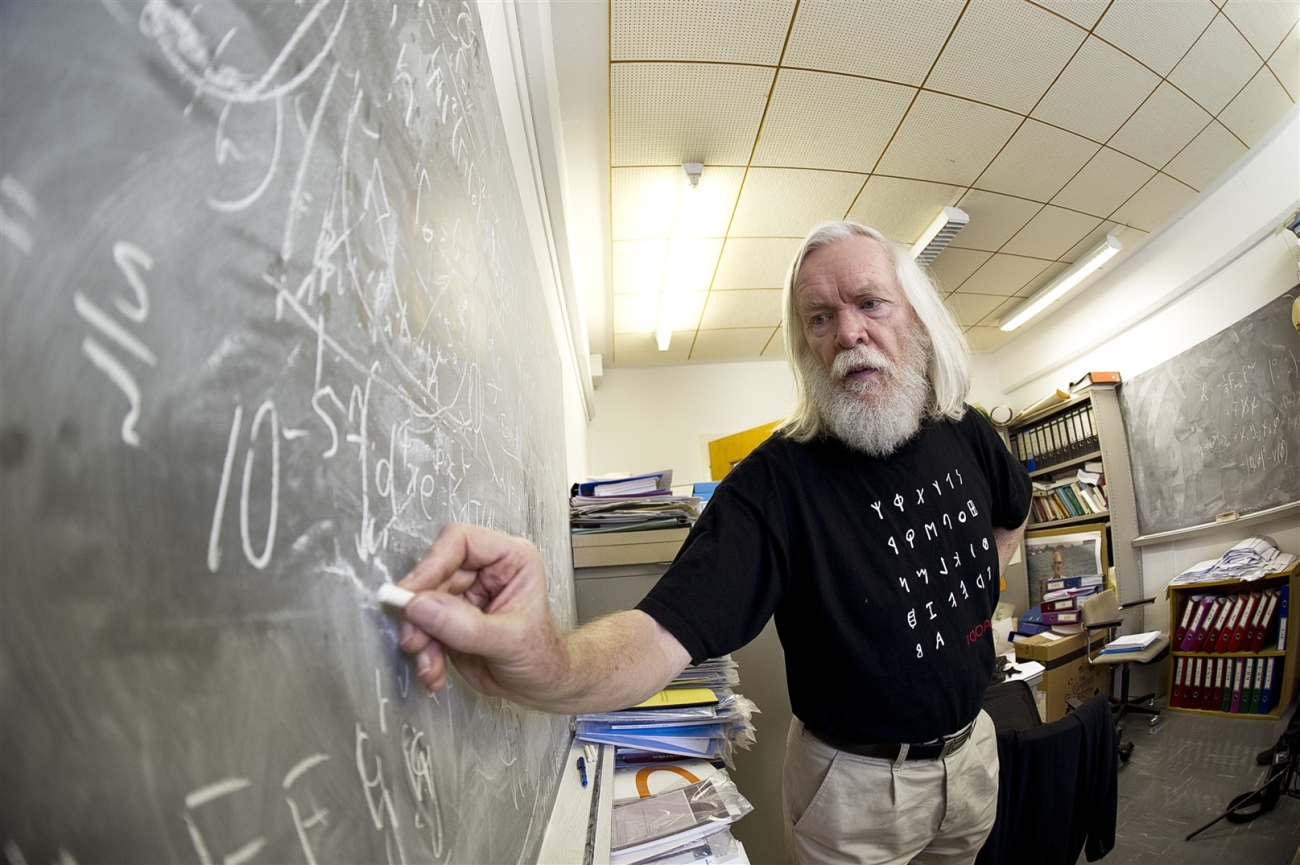
For John Ellis, the history of the Higgs boson is not a neat, short story that begins with a theory paper and ends with a discovery announcement. It is a long intellectual adventure, beginning in superconductivity, moving through the construction of the electroweak theory, and unfolding over decades of argument, calculation, indirect hints and failed or inconclusive searches before reaching CERN’s 4 July 2012 announcement, and continuing into the future. Ellis sees the Higgs discovery not as a conclusion, but as a springboard. The boson has been found, but the deeper questions attached to it — about naturalness, self-interaction, additional scalars, vacuum stability and the structure of physics beyond the Standard Model — remain open. In this conversation, marking his 80th birthday, he looks back on the long road to the Higgs, the roles of his collaborators Mary K. Gaillard and Dimitri V. Nanopoulos, and the future experimental programme needed to turn discovery into understanding.
Q: Looking back at the story of the Higgs boson, what do you think young physicists today should take from it?
John Ellis: One thing I would very much like younger physicists to remember is that many important problems in science often take a long time to resolve. The Higgs boson took 48 years from the time Peter Higgs wrote down his theory and made the boson explicit to the moment it was actually discovered, and the story continues. The discovery of gravitational waves took a century. Dark matter has been a serious scientific problem for around 90 years, and we still do not know what it is. So I think one lesson is patience. One should keep the big questions in view, but also accept that nature does not necessarily reveal her answers on the timescale we might prefer.
The other lesson is that the Higgs was never just one more particle. It mattered because it was tied to the internal consistency of the whole electroweak theory. For a long time, it was the missing piece in what was emerging as an increasingly successful framework. So the long search was not simply an exercise in perseverance; it was a test of whether our deepest ideas about the structure of matter and forces were actually right.
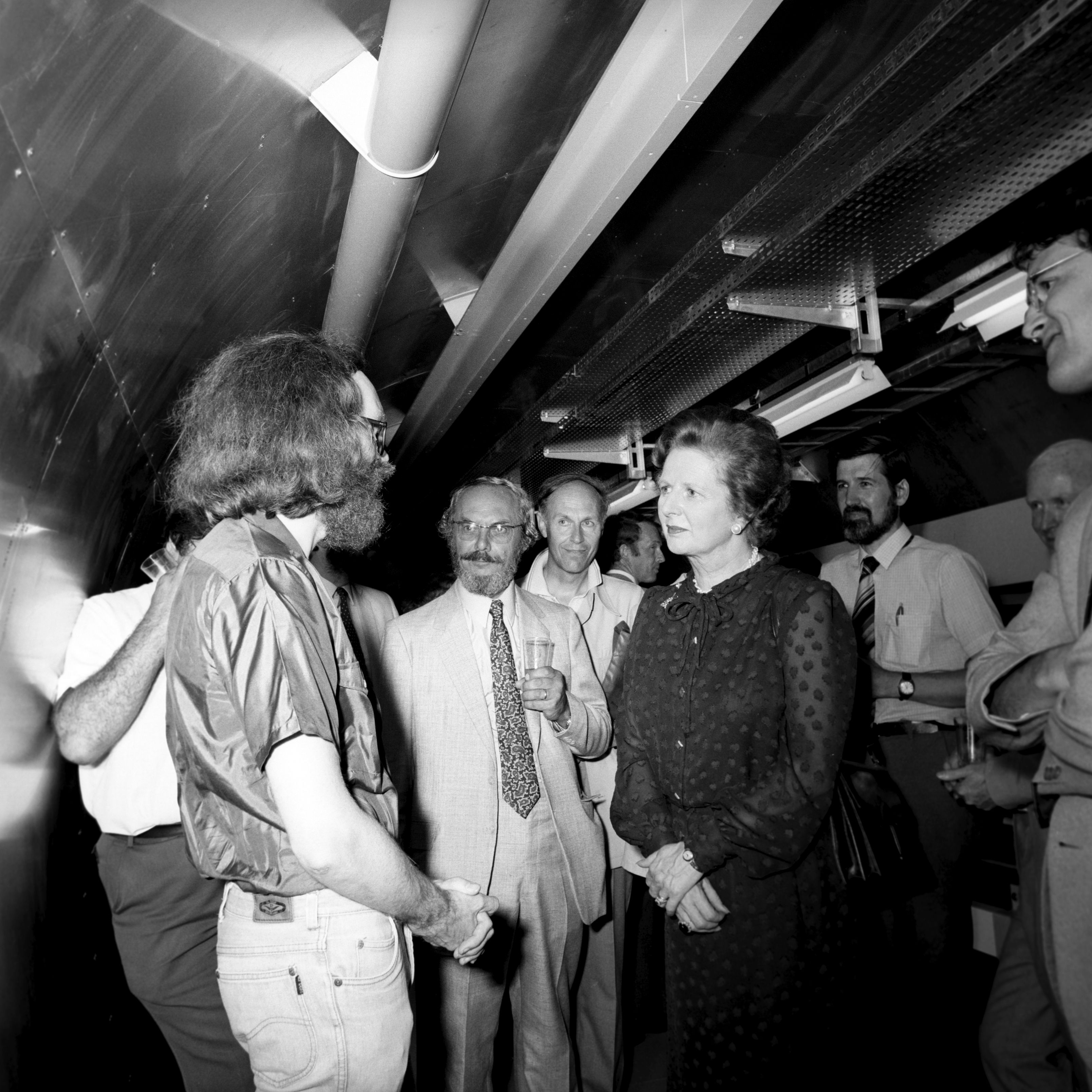
“What do you do, young man?” — Margaret Thatcher’s question to John Ellis during her visit to CERN as British Prime Minister in August 1982. Ellis replied: “As a theorist, I think of things for experimentalists to look for, but I hope they find something else.”
Q: What is the context for understanding the Higgs? Where did the story really begin?
John Ellis: It began before particle physics entered the story. The conceptual roots of the Higgs mechanism lie in condensed-matter physics, especially in the BCS theory of superconductivity. In that setting, one learns that the vacuum — more precisely, the lowest-energy state of the system — need not display all the symmetries of the underlying equations. This occurs in a superconductor, where the photon behaves as if it acquires an effective mass inside the medium. I prefer to describe this not as symmetry being broken, but as becoming hidden: the symmetry of QED that requires the photon to be massless in empty space is still there, but it is no longer manifest in an obvious way. This is the language used in the 2015 historical profile [1] I wrote with Mary Gaillard and Dimitri Nanopoulos, which traces the prehistory from BCS through Phillip Anderson and Yoichiro Nambu to the later electroweak formulation.
The breakthrough of 1964 was to show that a similar mechanism could be realised in a fully relativistic quantum field theory. That was done by François Englert and Robert Brout, independently by Peter Higgs, and later by Gerry Guralnik, Carl Hagen and Tom Kibble. What these papers established was that one could combine a massless gauge boson and a would-be massless Nambu–Goldstone boson into a massive vector boson without destroying the underlying gauge structure. That was a real conceptual revolution.
Q: You often make a distinction between the mechanism and the boson itself. Why is that important?
John Ellis: Because history matters. Englert and Brout had the essential idea of how such a theory could work, but they did not point out the important feature that Higgs made explicit: namely, that, in addition to massive vector bosons, such a theory should also contain a massive scalar boson. That is why the particle came to be called the Higgs boson. In that sense, the name reflects a specific historical contribution, even though the underlying mechanism has several parents. Our 2015 historical review [1] makes this point quite carefully: Higgs’s second 1964 paper is the only one of those original papers to mention explicitly the existence of the massive scalar particle associated with fluctuations in the radial direction of the famous “Mexican hat” potential.
So if one is speaking about the mechanism in general, one should really remember the broader cast of contributors. But if one asks why the particle bears Higgs’s name, there is a concrete historical answer to that.
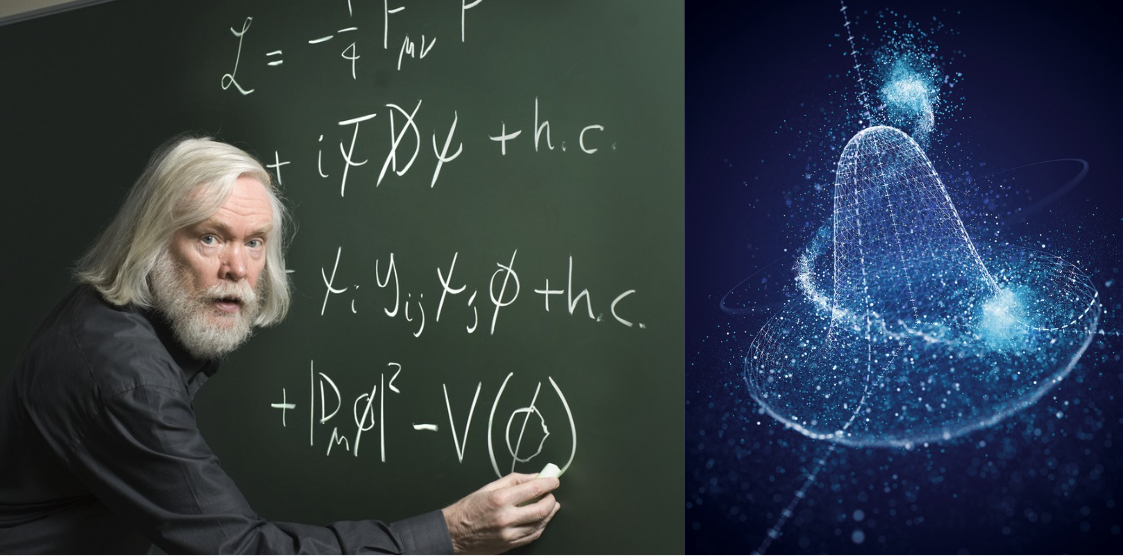
The formula that launched a thousand T-shirts: a playful reference to the Higgs potential, whose “Mexican hat” shape illustrates how the Higgs field can hide the symmetry of the underlying theory while giving rise to the Higgs boson.
Q: When did these ideas move from esoteric theory to something physicists began to take seriously?
John Ellis: That really happened in the early 1970s, and it was driven by two developments. Among theorists, the decisive step was the work of Gerard ’t Hooft and Martinus Veltman, who showed that these spontaneously broken gauge theories were renormalisable. In other words, they were not just exotic ideas; they were calculable theories with which one could make concrete predictions. For any theorist, that is a decisive threshold. It means you can begin to regard the theory as a serious candidate for a description of nature.
In parallel, experimentalists began looking for phenomena characteristic of the Glashow–Weinberg–Salam theory, in particular neutral currents, which were discovered in 1973 at CERN by the Gargamelle experiment. That, and the 1974 discovery of the J/ψ, really turned on the experimental community. So by 1975 you had an electroweak theory that was known to be mathematically consistent and beginning to receive experimental support. Many people naturally focused on the W and Z bosons, which were the obvious missing particles. But my collaborators and I felt that the deeper question was not simply whether those heavy vector bosons existed, but how they acquired mass. And the key signature of that mechanism was the Higgs boson.
Q: Is that what led Mary Gaillard, Dimitri Nanopoulos and you to work on the Higgs in 1975?
John Ellis: Yes, exactly. We felt that if the Standard Model was based on spontaneously broken gauge symmetry, then the clinching test of that whole paradigm would be the discovery of the Higgs boson. In our 1975 paper Mary, Dimitri and I describe it explicitly in those terms [2]. That conviction led us to write what became the first systematic phenomenological study of the Higgs boson. At the time, this was far from an obvious thing to do. The Higgs was not at the centre of the experimental agenda. The W and Z had not yet been found, the proton–antiproton collider that would later discover them had not yet been proposed, and there was no solid guidance on the Higgs mass, or even if it existed.
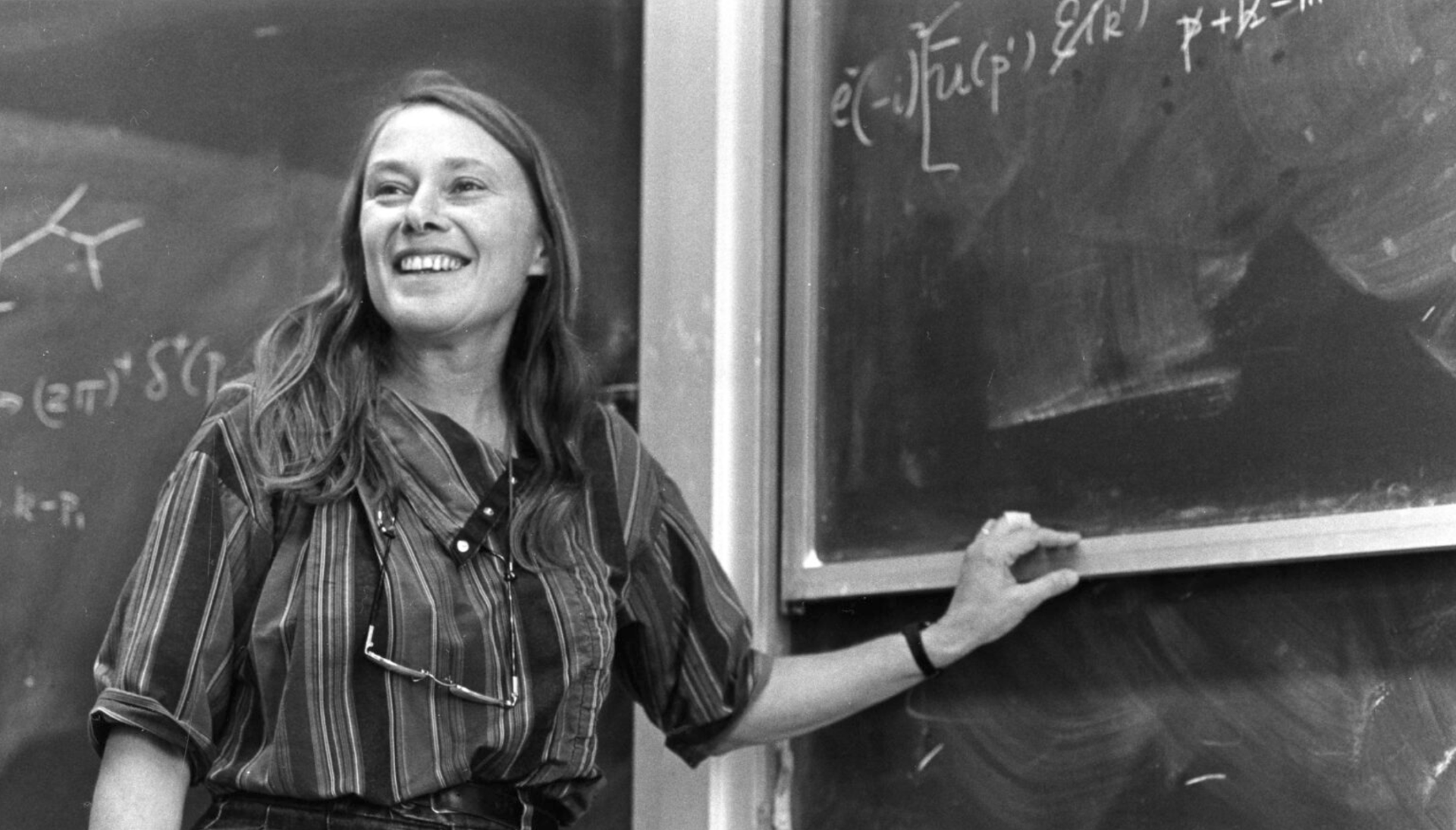
A youthful Mary K. Gaillard, radiating the energy and insight that would help shape the first systematic phenomenological study of the Higgs boson with John Ellis and Dimitri Nanopoulos in 1975.
In that 1975 paper [2], Mary Gaillard, Dimitri Nanopoulos, and I tried to ask very practical questions: if the Higgs exists, how might it decay, and how might one produce it? We considered Higgs masses up to around 100 GeV and much lower masses because, at the time, the bounds were extremely weak. One of the most important things we did was to calculate, for the first time, the quantum loop-induced decay into two photons, H→γγ. That turned out to be historically significant, because decades later it became one of the cleanest and most powerful discovery channels at the LHC. We also discussed production in hadronic environments and in e+e− collisions, including Z decays and production of the Higgs boson in association with a Z boson, which later became a standard Higgs-strahlung channel. In hindsight, our paper laid out several of the paths the field would follow for the next four decades.
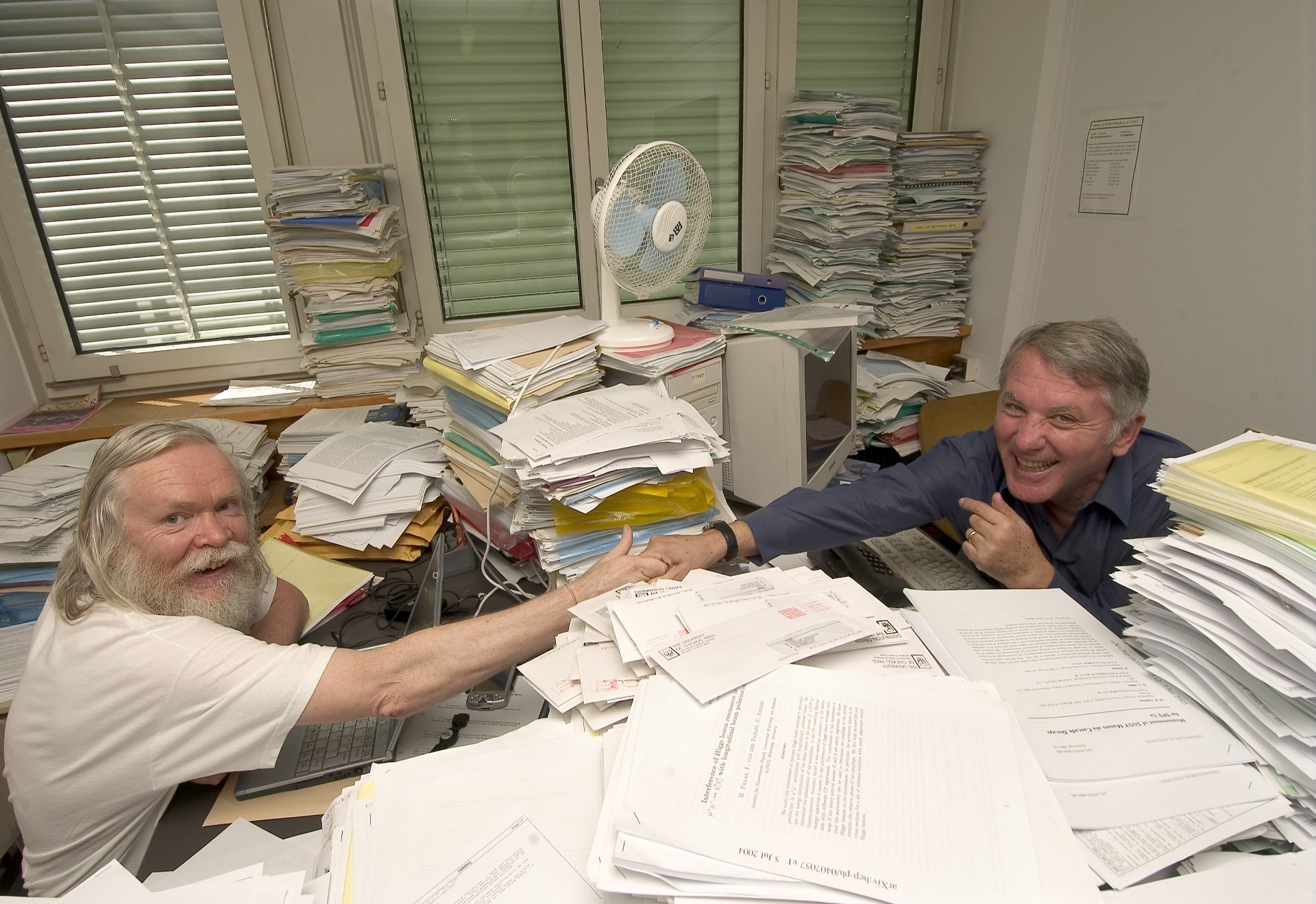
John Ellis with Dimitri Nanopoulos in 2005, recalling a long scientific collaboration that included, with Mary K. Gaillard, the first systematic phenomenological study of the Higgs boson in 1975.
Q: And yet your 1975 paper famously ended with a note of caution.
John Ellis: Yes, and that is one of the things that still amuses me. We ended by saying, more or less tongue-in-cheek, that we did not want to encourage large experimental searches for the Higgs boson. The reason was not that we thought that the search for the Higgs boson was unimportant. Quite the opposite. The difficulty was that we had no reliable estimate of the mass, and the couplings were not yet precisely enough pinned down for experimentalists to know where to focus. So it seemed prudent to say: people whose experiments are vulnerable to the Higgs should at least know how it might appear, but we are not yet in a position to launch a grand campaign. The paper says exactly that.
Of course, history took a more ambitious course. Fortunately, experimentalists ignored our caution and pursued the Higgs with great perseverance.
Q: How did the search become more concrete after that?
John Ellis: A major step was the development of LEP. During the academic year 1975–76, Burt Richter was on sabbatical at CERN and thinking about very large electron–positron colliders. Out of that period came the basic vision that eventually led to LEP. CERN set up a working group to think about the machine, and Mary Gaillard and I were asked to write the theoretical chapter. Much of what we discussed concerned precision weak interactions, but Higgs production naturally became part of the physics case. The later historical review records this progression very clearly: after our 1975 paper, the first serious discussions of Higgs searches in e+e− collisions appeared, first in Z decays and then via associated ZH production.
At first, the experimental interest was still limited. The historical paper actually notes that the earliest CERN reports on LEP physics [3] contained only theoretical discussions of Higgs production, not experimental search plans. It was only gradually, through the late 1970s and 1980s, that the Higgs moved firmly into the sights of the LEP collaborations. That is an important reminder that what later seems inevitable often unfolds very slowly in real time.
Q: At what point did the Higgs become central rather than peripheral?
John Ellis: The decisive turning point was the discovery of the W and Z bosons in 1983. Up to then, the Higgs was generally regarded as something of a niche interest. But once those heavy weak bosons were discovered, the question became unavoidable: how do they get their mass while the photon remains massless? At that stage, the Higgs could no longer be regarded as an optional embellishment of the theory. I compare it to the capstone of an arch. If the capstone is missing, the whole arch collapses. That is how we saw the Higgs in relation to the electroweak theory.
From then on, the search widened in several directions. There were detailed LEP studies, hadron-collider studies, and increasingly sophisticated theoretical analyses of production and decay modes. The 2015 historical profile [1] also reminds us that several important hadron-collider channels were developed in this period, including gluon–gluon fusion and associated production with vector bosons. Dimitri Nanopoulos appears there again in a central role: he co-authored key papers on Higgs production in hadron collisions.
Q: How important were indirect hints from precision data?
John Ellis: They were enormously important. Once LEP and SLC began producing precision electroweak measurements, one could use loop corrections to infer something about particles that had not yet been directly seen. The sensitivity to the top-quark mass was relatively strong, but the sensitivity to the Higgs mass, though only logarithmic, was still meaningful. With my collaborators Gianluigi Fogli and Eligio Lisi [4], we worked on extracting bounds on the Higgs mass from the data. The historical review notes that values below about 300 GeV were already favoured quite early in that programme, and that the indirect estimate became increasingly restrictive over time.
That changed the psychology of the search. The Higgs was no longer just a missing particle somewhere in an enormous parameter space. The data were beginning to whisper that it was probably relatively light. By around the year 2000, the evidence was that the Higgs mass was probably below about 200 GeV. It had not shown up at LEP, but the combination of precision data and direct exclusions was narrowing the likely window.
Q: And then came the famous LEP drama. How do you look back on it now?
John Ellis: LEP1 had excluded the Higgs at masses below about 50 GeV in Z decays, and then LEP2 pushed the lower limit up to about 114 GeV. In the year 2000, ALEPH observed suggestive events near 115 GeV, and there was considerable discussion about whether LEP should continue running. At the time, many people, myself included, were unhappy when the decision was made to stop LEP and not delay LHC. But in hindsight, the decision was the right one. The 115 GeV hint was not the Higgs; it was a statistical fluctuation. And the actual Higgs mass, around 125 GeV, was beyond LEP’s practical reach without much larger earlier investments in accelerating cavities. The 2015 historical profile is very clear on that point.
At the same time, the LEP years were not a failure. They set the lower bound on its mass, provided an indirect upper bound, and they taught us how precision could guide discovery long before discovery itself arrived.
Q: What role did the Tevatron play between LEP and the LHC?
John Ellis: An important one. During the 2000s, while ATLAS and CMS were being built, the Tevatron was advancing the Higgs search. The experimentalists there knew perfectly well that precision data suggested the Higgs should be lighter than about 200 GeV, and they devoted major efforts to search for it. They were able to exclude a chunk of the allowed mass range around 160 GeV, and they even saw a modest hint at lower mass, though not enough to claim anything significant. If the Tevatron had continued longer it could have strengthened that hint. But by then the LHC had arrived, and US took the strategic decision to move to the more powerful machine.
So by 2011 the picture was becoming rather compelling: the Higgs had to be above the LEP limit, was excluded in a middle range by the Tevatron, and was probably below 200 GeV. The field was converging on the discovery before the discovery itself.
Q: The LHC was designed with Higgs signatures in mind. How much did those early studies matter?
They mattered a great deal. One very characteristic feature of the Higgs is that even if you do not know its mass, once you assume a mass, you can predict how it should be produced and how it should decay. Because the Higgs boson is associated with the generation of mass, its couplings to other particles are proportional to their masses. So a Higgs of 200 GeV would decay readily to pairs of W or Z bosons; a heavier Higgs could decay to top-antitop pairs; a lighter Higgs has different dominant signatures. That meant the discovery experiments could be designed with quite specific search strategies in mind.
One of the channels that received particular attention was the diphoton decay, precisely because of our 1975 work [2] with Mary Gaillard and Dimitri Nanopoulos. We had shown that quantum loop diagrams would generate H→γγ, which would provide a very clean signature because photons can be measured with great precision. ATLAS and CMS took this possibility seriously. In CMS, for example, a great deal of effort went into building an electromagnetic calorimeter capable of measuring photons with very high precision. So when the discovery came in 2012, it did so partly through channels whose relevance had been recognised decades earlier.
Q: On 4 July 2012, was it immediately clear that the new particle was the Higgs boson?
John Ellis: Not completely. It was clear that ATLAS and CMS had found a new particle in channels where one expected a Higgs boson to appear, but one still had to ask whether it was genuinely the Higgs or some impostor. The 2015 historical profile lists the key questions very systematically: what is its spin? Is it a scalar or a pseudoscalar? Is it elementary or perhaps composite? Do its couplings to other particles scale with mass in the way expected? And do its loop-induced couplings behave as the Standard Model predicts? Those were the tests that had to be passed.
What is striking is how well the new particle has performed in those tests. The data strongly support spin zero. They also strongly prefer a scalar over a pseudoscalar state. Its couplings are consistent with the mass-proportional pattern expected in the Standard Model. And the quantum loop-induced processes, such as production by gluon fusion and decay to two photons, also look very Standard-Model-like. So over time, the case became stronger and stronger that this really is the Higgs boson, or at least something very close to the minimal Standard Model version of it.
Q: If the Higgs looks so Standard-Model-like, what are the big unresolved questions now?
John Ellis: There are several, and they are all quite profound. One is the question of naturalness. Why is the Higgs mass so small compared with the very high scales that seem to enter the deeper structure of physics, such as the Planck scale of gravity? In an ordinary elementary-scalar theory, loop corrections push the mass upward. That is why many of us were attracted to supersymmetry, which can cancel the dangerous quadratic divergences. In our 2015 historical review [1], Mary, Dimitri, and I also emphasized another related point: given the measured Higgs and top masses, the Standard Model seems to place the electroweak vacuum uncomfortably close to metastability. That may be another hint that some new physics, perhaps supersymmetry, is needed below very high scales.
A second unresolved issue is flavour. We know that the Higgs couplings scale with particle masses, but the Standard Model does not explain why those masses take the values they do. We still do not understand why the electron is so light, why the muon is about 200 times heavier, and why the pattern of quark and lepton masses looks the way it does. The Higgs gives us a mechanism for mass generation, but not an explanation of the mass hierarchy.
A third question concerns the Higgs self-interaction. In the simplest theory, there is a definite prediction for the coupling of three Higgs bosons. Measuring that is extremely difficult, because it requires observing Higgs-pair production in very challenging conditions. But it is one of the principal goals of the High-Luminosity LHC, because it gives direct information about the shape of the Higgs potential itself, which controlled the early history of the Universe. The present measurements are consistent with the Standard Model prediction, but the uncertainties are still large.
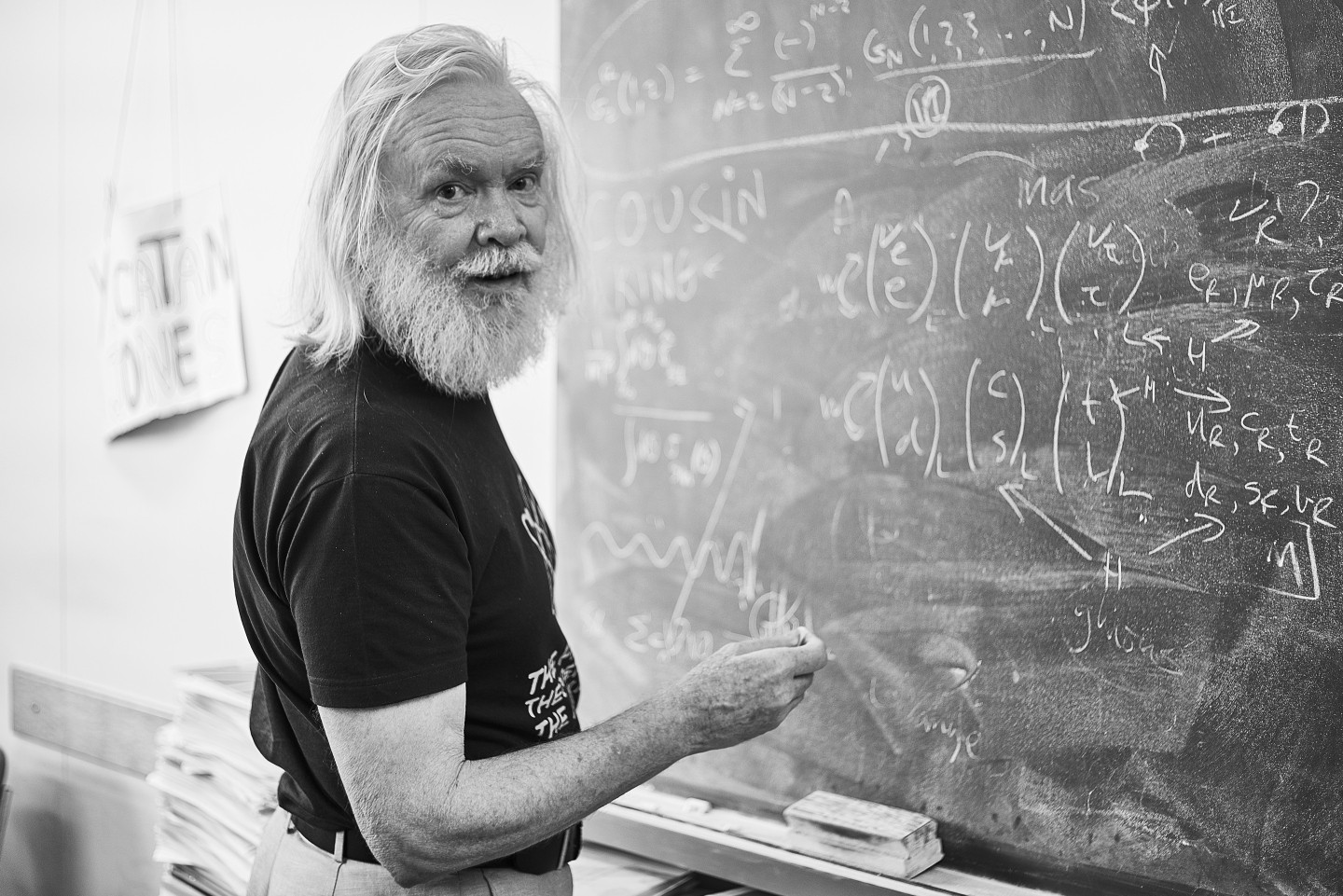
John Ellis in 2017, enjoying the flavour problem — one of the unresolved puzzles left open by the Higgs mechanism: why quarks and leptons have the masses and patterns of couplings that they do.
Q: This takes us naturally to future colliders. How do you see the role of FCC-ee?
John Ellis: I would not want people to think of FCC-ee only as a Higgs factory, though of course it is that. It is more broadly an electroweak factory. It would produce truly enormous numbers of Z bosons — trillions of them — as well as very large samples of W bosons and Higgs bosons. The importance of that is not just that one gets lots of events. It is that one can make fantastically precise measurements, and precision measurements have already shown their power in the history of the Standard Model. They gave us clues to the top mass and to the Higgs mass before either particle was directly found. In the same spirit, future ultra-precise measurements could provide windows onto other heavy particles that we have not yet seen.
Different machines have complementary strengths: the HL-LHC pushes Higgs measurements and direct searches further; linear colliders offer higher energies in e+e−; circular colliders such as FCC-ee provide higher luminosities at the Z pole, the WW threshold and the ZH threshold; and a large circular tunnel would also open the possibility of a 100-TeV proton collider later on. My own view is that this versatility is very attractive, because it combines precision with eventual direct reach.
Q: Are there examples of measurements that become especially interesting in that future programme?
John Ellis: Yes. One example is the process e+e−→ZH, which allows very clean Higgs measurements. Another is the Higgs decay into two photons. That decay is especially interesting because it is a quantum effect. The Higgs does not couple directly to the photon, so the decay proceeds through loops, and that means it is sensitive to additional massive charged particles that might exist beyond the Standard Model. If there are such particles, they can leave their imprint there even if they are too heavy to be produced directly. So a channel that was once interesting simply as a discovery mode becomes, in a precision era, a window onto possible new physics.
And of course there is the triple-Higgs coupling. That was not really on the agenda when the LHC was first conceived in the early 1990s. At that time, people were focused much more on whether the Higgs existed at all, or whether something else would replace it. But the success of the LHC has changed the agenda. Now that the Higgs is real, we can ask more ambitious structural questions about the Higgs sector itself.
Q: You are interested in axions, atom interferometry and gravitational waves. Do these interests connect back to Higgs physics in some way?
John Ellis: I think they connect through a broader perspective. In all these cases, one is trying to extract deep structure from subtle signals. With axions, one is addressing the strong CP problem and asking whether there exists a new light pseudoscalar boson, such as those that can arise in extended Higgs sectors. With atom interferometry and gravitational waves, one is again trying to probe fundamental questions through very delicate observables and new experimental techniques that are complementary to the LHC and FCC. So although these topics are different on the surface, they all belong to the same larger effort to look beyond the present Standard Model using every available window.
Q: Your recent writing also ranges beyond the Higgs into quarkonium and toponium. Is there a common thread there, too?
John Ellis: Yes, I think there is. In one way or another, these stories all have to do with how physics progresses through inference, patience and the gradual strengthening of evidence. In the memoir I recently wrote on fifty years of quarkonia, I found myself recalling the atmosphere that surrounded the early Higgs years: signals first appear as something puzzling and perhaps easy to misread, and only gradually does a larger theoretical structure emerge around them. After the discovery of the J/ψ in 1974, for example, there were intense discussions — sometimes late into the night — about what exactly had been found. At CERN we even put out a collective anonymous preprint under the name of the “CERN Theory Boson Workshop,” because it felt more like a common effort to think through the implications than a competition for priority. Mary Gaillard is very much part of that wider story too, not only in Higgs physics but in the development of charm phenomenology and later heavy-quark studies.
I remember, too, that when the ψ′ was discovered, some people thought it was evidence against the charmonium interpretation of the J/ψ. My own instinct was the opposite: it seemed natural that it could be a radially excited charm-anticharm state, excluding other interpretations. What first looked problematic opened up a coherent spectroscopy. I think that same pattern appears again and again in particle physics. Apparent anomalies can open doors. Even the story of the “penguin diagram,” amusing name though it is, belongs to that larger theme: what begins as an apparently technical theoretical idea can become part of the architecture of the subject.
When one comes to toponium, one finds a similar physical structure at a much higher mass scale. There are now intriguing threshold phenomena and spin-correlation effects that are probably revealing to us a ttˉ state. But whether those signals ultimately point to toponium or possibly some heavy Higgs-like interpretation (my personal interest) remains to be fully settled, though Occam’s razor probably favours the toponium interpretation. The common thread is the attempt to recognise deep structure in subtle evidence.
Q: Another major episode in your career was the discovery of the gluon. How did that story unfold, and what was the theoretical environment at the time?
John Ellis: The gluon story is another example of how a theoretical idea can become an experimental reality, but it developed on a much shorter timescale than the Higgs. In the mid-1970s, quantum chromodynamics, or QCD, was already regarded by many theorists as the most plausible theory of the strong interactions, but it was still often described as a candidate theory. It had several strong arguments in its favour: asymptotic freedom, the approximate scaling observed in deep-inelastic scattering, the emerging pattern of scaling violations, and the qualitative success of QCD in making sense of the charmonium spectrum. But there was still no direct experimental proof of the gluon itself. What was missing was what I later called a “smoking gluon.”
At the same time, jet physics was just beginning to emerge. Two-jet events had been observed statistically in electron–positron annihilation at SPEAR, but the interpretation of high-transverse-momentum phenomena was still debated. There were rival ideas, and it was not yet obvious that QCD would provide the final framework. So the question was: how could one find direct evidence for the gluon in a clean experimental environment?
One day in 1976, I was walking back from the CERN cafeteria to my office, crossing the bridge and turning the corner by the library, when the idea occurred to me. The simplest place to look for the gluon would be in electron–positron annihilation. Normally, the electron and positron annihilate into a quark–antiquark pair, which appears experimentally as two jets. But every now and then, one of those quarks should radiate a gluon, rather like an energetic electron radiating a photon. If that gluon had enough energy, it should appear as a third jet. That was the basic idea: look for three-jet events as evidence for gluon bremsstrahlung.
Together with Mary Gaillard and Graham Ross, we calculated how this process would appear in QCD [5]. We showed that gluon bremsstrahlung should lead to jet broadening and, at sufficiently high energies, to clear three-jet events. We also compared the QCD prediction with the possibility of scalar gluons, because one also had to ask not only whether the gluon existed, but what kind of particle it was.
The next important step was communication with experimentalists. I was in close contact with colleagues at DESY, especially Bjørn Wiik, who was enthusiastic about the idea. When I gave a seminar at DESY, however, the reaction from some theorists was sceptical, even hostile. They questioned whether the short-distance QCD structure would survive the messy process of hadronization. My answer was that hadronization should be a soft process, involving relatively small momentum transfers, and that two-jet events had already been seen. But this scepticism was useful: it forced the arguments to be sharpened.
The experimental situation changed rapidly when the PETRA lepton collider at DESY reached sufficient energy. In 1979, the TASSO collaboration and the other PETRA experiments began to see clear evidence for three-jet events. The first news came in June 1979, then further evidence was shown at the European Physical Society conference in Geneva in July, and the public announcement came at the Lepton/Photon Symposium at Fermilab in August. All four PETRA experiments — TASSO, JADE, PLUTO and Mark J — presented evidence. It was not always easy in a single event to say which jet was the gluon, but the overall pattern was clear: one of the three jets had to be the gluon.
So that was a discovery to which I am very glad to have contributed. It was also a textbook example of how theorists and experimentalists can work together. A small group of theorists had an idea about how to see the gluon, shared it with experimental friends, and the experimentalists seized the opportunity. In that sense, the gluon story is not only about QCD; it is also about the sociology of discovery.
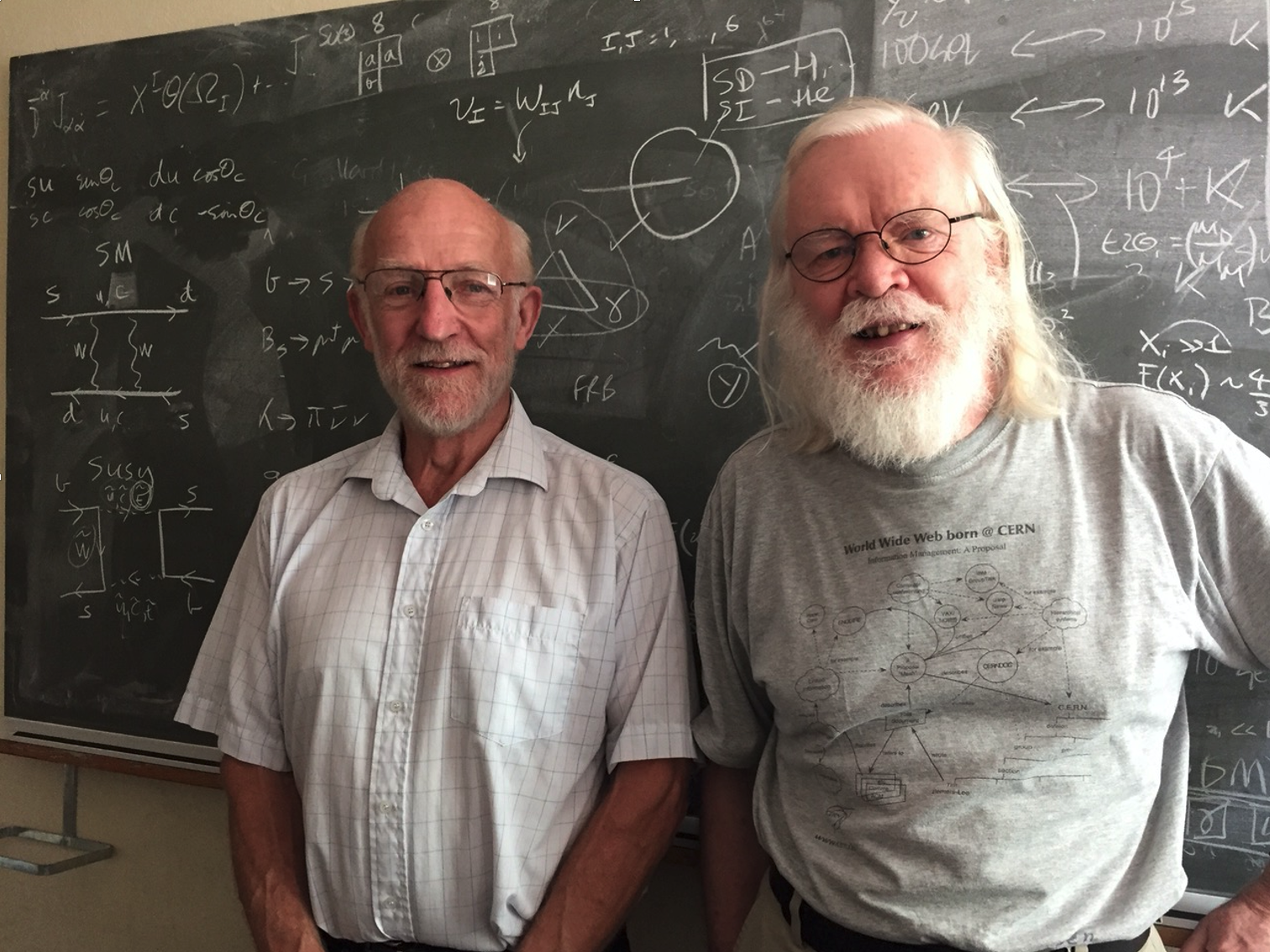
John Ellis with Graham Ross at CERN in 2019, recalling their collaboration on the theoretical work that helped point experimentalists towards the discovery of the gluon.
Q: In that story, there is also a strong lesson about how discoveries mature — from indirect evidence, to a proposed signature, to experimental confirmation. Did that influence how you later thought about the Higgs and other searches?
John Ellis: Yes, I think so. The gluon story showed very clearly that one often does not discover a particle simply by “seeing” it in isolation. One discovers it through a pattern of events, through distributions, through the comparison of different hypotheses, and through the gradual strengthening of evidence. With the gluon, three-jet events were the key, but one still had to ask whether the gluon was really the vector particle predicted by QCD or something else, such as a scalar particle. Inga Karliner and I proposed a way [6] to distinguish those possibilities, and TASSO later used such methods to show that the gluon was indeed a vector particle, as QCD required.
That is very similar in spirit to what later happened with the Higgs. On 4 July 2012, ATLAS and CMS had discovered a new particle in the right channels, but it still had to be tested. Was it spin zero? Was it a scalar? Did its couplings scale with mass? Did the loop-induced processes behave as expected? The discovery announcement was therefore not the end of the story, but the beginning of a long programme of identification and precision measurement.
There is also another parallel. Gluon studies did not stop once the gluon was discovered. They became a precision tool for testing QCD. At LEP, three-jet and four-jet events were used to measure the strong coupling, test its running with energy, and verify the non-Abelian structure of QCD, including the three-gluon coupling. In the same way, Higgs physics after 2012 has become a precision programme. The question is no longer simply “does the Higgs exist?” but “is it exactly the Standard Model Higgs, or is it giving us indirect clues to something deeper?”
So yes, I think the gluon story reinforces a broader lesson: discovery in particle physics is often a process, not a single moment. A theoretical framework suggests a signature; experimentalists find patterns in the data; the community tests alternative interpretations; and only gradually does the evidence become compelling.
Q: Around the same period, particle physics was also becoming increasingly connected with cosmology and astrophysics. Looking back, did that wider cosmic perspective influence your career and the way you approached fundamental questions?
John Ellis: I first became seriously interested in the connections between particle physics, astrophysics and cosmology in the late 1970s. At that time, it was becoming increasingly clear that the very small and the very large could not be kept in separate intellectual boxes. The physics of elementary particles was relevant to the early Universe, and the Universe itself was beginning to offer new ways of testing fundamental physics.
Then, in the early 1980s — specifically in 1983 — we realised that the lightest supersymmetric particle would be an excellent candidate for dark matter, if it existed. We still do not know whether it exists, of course, but that idea was very important for me because it made the connection between particle physics and cosmology concrete. A particle proposed for reasons internal to high-energy physics could also explain one of the great mysteries of the Universe.
That strengthened my sense that particle physics and cosmology are really part of the same enterprise. If one is trying to understand the fundamental laws of physics, one can do so with collider experiments, but also with non-collider experiments. The Universe offers a remarkable range of such experiments: dark-matter searches, cosmic microwave background measurements, gravitational waves, cosmic rays, neutrinos and many others.
So I move backwards and forwards between particle physics, astrophysics and cosmology. Last year, for example, I wrote several papers on models of inflation which could be due to a Higgs-like field. One of my continuing interests is the extent to which gravitational-wave observations can be used to constrain fundamental physics. This is also why I am interested in projects such as atom interferometry and ultralight dark-matter searches. They may look very different from colliders, but intellectually they belong to the same search.
I would not draw a sharp boundary between the Higgs, supersymmetry, dark matter, inflation or gravitational waves. They are different windows onto the same underlying question: what are the fundamental laws of nature, and how can we persuade nature to reveal them.
Q: If you had to say, in the broadest sense, what the Higgs means today, what would you say?
John Ellis: I would say that the Higgs is not just the culmination of the Standard Model story, but the point at which the next story begins. For decades, it was the missing piece of an increasingly impressive theory. Its discovery closed that chapter. But precisely because the discovered particle looks so much like the Standard Model Higgs, it sharpens all the remaining questions. Why is the Higgs so light? Is the vacuum absolutely stable? Is there only one scalar field, or a richer Higgs sector? Can precision Higgs measurements reveal virtual effects of new particles? Is supersymmetry waiting at a higher scale, or is the answer something quite different? The Higgs has not removed those questions. It has made them more urgent.
That is why I do not think of 2012 as a conclusion. It was a beginning — the beginning of the “après-Higgs” era. The task now is not merely to celebrate the discovery, but to understand what it is trying to tell us.

John Ellis deep in thought in 2019 — an image that captures the reflective spirit of the interview, from the long road to the Higgs boson to the open questions that continue to shape particle physics.
Q: You’ve spent decades thinking about heavy particles at colliders. Why turn now to ultralight dark matter and the AICE atom interferometer?
John Ellis: I would not describe it as turning away from colliders so much as broadening the range of possibilities we are prepared to test. For a long time, many of us expected that dark matter might take the form of relatively heavy particles of the WIMP type, and of course, the LHC has played a major role in exploring that possibility. But so far, nature has not rewarded that expectation. That does not mean the collider programme has failed; it means we have to enlarge the net. One very interesting alternative is that dark matter may be composed of ultralight bosonic fields — particles such as axion-like fields, dark photons, or dilaton-like states — which would behave less like individual particles in a detector and more like coherent waves spread over macroscopic distances. That calls for different experimental tools. The idea behind AICE is precisely to use one of those tools, atom interferometry, to look for the tiny effects such fields might induce in atomic systems. CERN is the ideal place to perform such an experiment, and the experiment we are proposing at CERN is designed not only for ultralight dark matter searches but also as a pathfinder for gravitational-wave measurements in a frequency band that remains largely unexplored. [7]
Q: AICE is an idea for a vertical 100-metre experiment at CERN. How does throwing atoms up a shaft actually help you look for dark matter?
John Ellis: On the face of it, it may sound like an updated version of a Galileo experiment, but in reality, it is an extremely sophisticated form of quantum sensing. One begins with very cold atoms — whose wave nature can be controlled with lasers. In an atom interferometer, laser pulses are used to place the atoms into a quantum superposition of separate paths and then recombine them later. The resulting interference pattern is exquisitely sensitive to extremely small perturbations. If an ultralight bosonic dark-matter field couples to the electron or other atomic constituents, it can produce tiny shifts in atomic transition energies and interference phases. Gravitational waves could produce similar phase shifts. Those shifts are minute, but an interferometer is designed precisely to measure that sort of minute effect. So one is not “seeing” dark matter in the ordinary sense. One is searching for its imprint on the behaviour of matter waves. That is what makes the method so powerful and complementary to high-energy collisions.
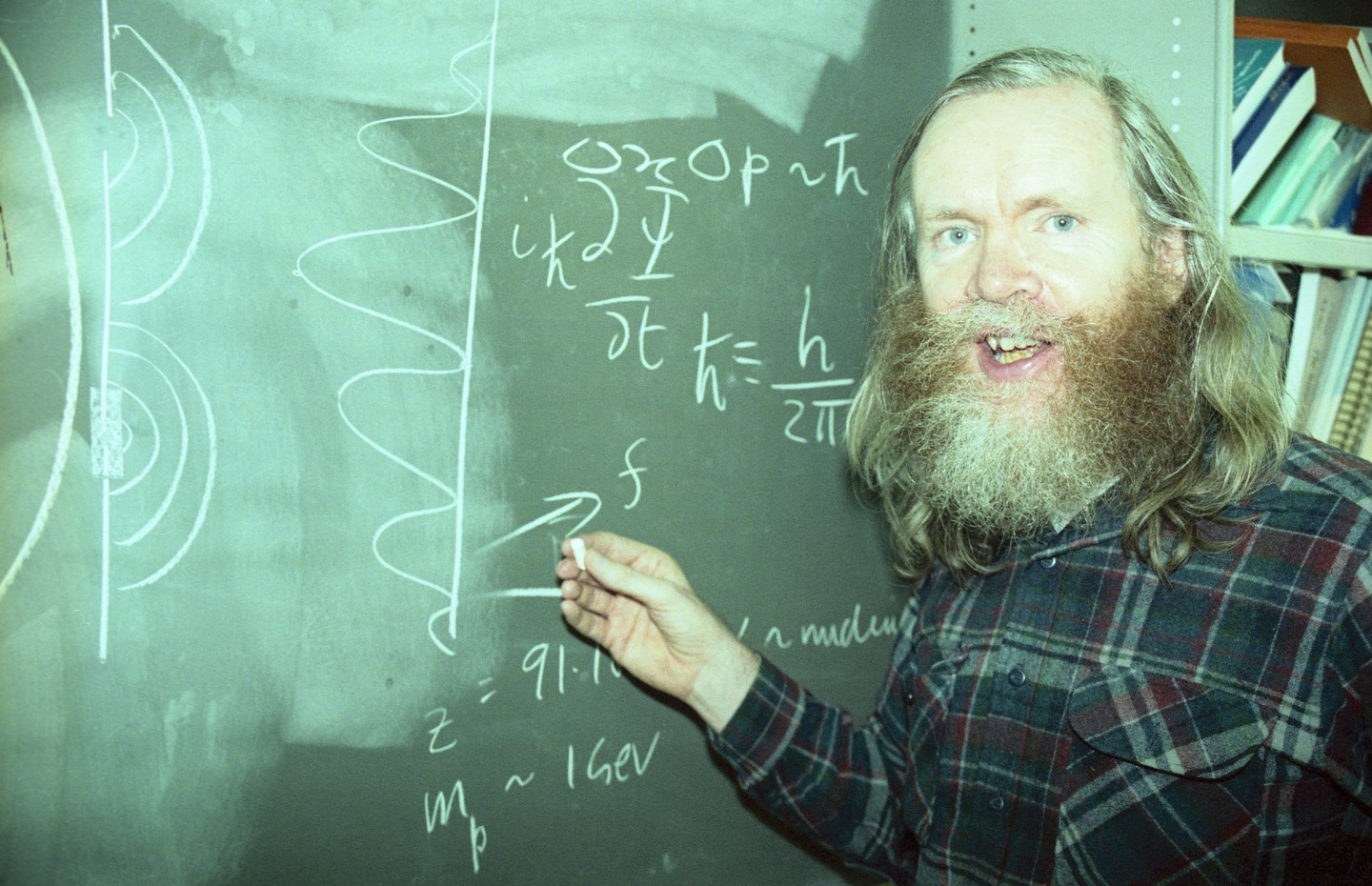
John Ellis in 1993, reflecting on quantum mechanics — from the foundations of theory to the quantum-sensing techniques now being explored for dark-matter and gravitational-wave searches.
Q: Why build this at CERN? Why not somewhere quieter, like a mountain laboratory or a deep underground site?
John Ellis: CERN is attractive for a very specific reason: it already has a suitable large-scale infrastructure and the relevant technical culture. The present AICE proposal is to install an atom interferometer of order 100 metres in the PX46 shaft, one of the LHC access shafts. That immediately gives one a long vertical baseline, which is valuable because sensitivity improves with interrogation time and separation scale. Just as importantly, CERN has enormous expertise in vacuum systems, precision engineering, environmental control and the operation of demanding scientific infrastructure. The Letter of Intent stresses that the site has already been studied with respect to shielding, access, and compatibility with LHC operation. So the attraction is not simply that there is a convenient hole in the ground. It is that one can use CERN's experience and technical infrastructure to pursue a complementary frontier experiment. Let us hope that with AICE or the HL-LHC, we can unravel the mystery of dark matter before its 100th birthday!
Q: You’ve said that AICE could also be a forerunner for “mid-band” gravitational-wave astronomy. What is the “mid-band”, and why is it so interesting?
John Ellis: At present, the available gravitational-wave instruments are sensitive in very different frequency ranges. Ground-based laser interferometers such as LIGO are most sensitive at relatively high frequencies, while the future space-based mission LISA will probe much lower frequencies. Between them lies an intermediate region — the so-called mid-band — that cannot be explored using laser interferometry. Studies of atom-interferometric detectors can explore frequencies between some tens of millihertz and a few hertz, though the exact boundaries depend on the design. This frequency band is scientifically very important because it could allow us to study mergers of black holes that are inaccessible, or only partially accessible, to either LIGO or LISA alone. It could provide an earlier view of inspiralling compact binaries and improve our understanding of how black holes of different masses grow and merge over cosmic time. The AICE concept is intended in part as a demonstrator for this kind of future detector. [8]
Q: Let’s turn to the Moon. Why look there for radioactive isotopes, and why is looking for plutonium-244 so much more difficult — and so much more interesting — than iron-60?
John Ellis: In 1996 Brian Fry, David Schramm and I suggested geological searches for radioactive isotopes such as iron-60 and plutonium-244 that would have been formed in nearby astrophysical explosions and inform us in different ways about the astrophysical history of the solar neighbourhood [9]. Starting in 1999, Iron-60 has been detected in deep-sea deposits on Earth and in lunar material, and its presence is widely interpreted as evidence for one or more relatively nearby astrophysical explosions, probably supernovae, within the last few million years. Plutonium-244 is far rarer and is associated with r-process nucleosynthesis, meaning environments with extremely intense neutron fluxes, such as neutron-star mergers (which are enabled by the radiation of gravitational waves and produce elements essential for human life such as iodine) or other rare explosive events. What makes plutonium-244 detection difficult is its scarcity and the challenge of measurement. A 2021 Science paper found small quantities of plutonium-244 accompanying iron-60 deposits on Earth, and our subsequent studies emphasize that extended measurements would help distinguish among possible source scenarios. So plutonium-244 is interesting because it may tell us not only that something happened nearby, but what kind of event it was, a supernova or a much rarer neutron-star merger, and whether such events made our life possible or could endanger it. [10]
Q: So what is the case for looking on the Moon rather than only on Earth?
John Ellis: The Moon is valuable because it preserves a cleaner record extending over a longer period of time. On Earth, geological activity, ocean circulation and biological processing complicate the story. On the Moon, by contrast, the surface regolith can retain a direct archive of deposited interstellar material over long periods. That is why lunar samples have already proved important in the study of Iron-60 [11], and why we have been advocating using future lunar samples to search for other radioactive isotopes such as plutonium-244 and iodine-129 [12]. One can think of the lunar surface as a kind of long-duration archive of the astrophysical environment of the Solar System. If future missions were to recover well-characterised cores and measure both Iron-60 and plutonium-244 with sufficient sensitivity, that could tell us a great deal about nearby explosive events in our galactic neighbourhood, and possibly clarify our origins and our fates.
Q: There is something rather beautiful in that image — going to the Moon to understand the stars.
John Ellis: Yes, I think so too. One of the appealing things about this line of work is that it reminds us how interconnected different parts of physics really are. You can begin with particle physics, move into nuclear astrophysics, then into lunar science, and still be asking a single underlying question: what does the universe contain and how does it evolve? In that sense, whether one is studying the Higgs boson, ultralight dark matter, gravitational waves or radioactive traces in lunar soil, the intellectual impulse is very similar. One is trying to extract hidden physics from subtle evidence. That, to my mind, is one of the most satisfying things about the subject.
References
- J. Ellis, M. K. Gaillard and D. V. Nanopoulos, “An Updated Historical Profile of the Higgs Boson” arXiv:1504.07217
- J. Ellis, M. K. Gaillard and D. V. Nanopoulos, “A Phenomenological Profile of the Higgs Boson” , Nuclear Physics B 106 (1976) 292–340. DOI: 10.1016/0550-3213(76)90382-5.
- L. L. Camilleri et al., “Physics with Very High-Energy e⁺e⁻ Colliding Beams” , CERN Yellow Report CERN-76-18, CERN, Geneva, 1976. DOI: 10.5170/CERN-1976-018.
- J. Ellis, G. L. Fogli and E. Lisi, “Indirect Bounds on the Higgs Boson Mass from Precision Electroweak Data” , Physics Letters B 318 (1993) 148–154. DOI: 10.1016/0370-2693(93)91798-R.
- J. Ellis, M. K. Gaillard and G. G. Ross, “Search for Gluons in e⁺e⁻ Annihilation” , Nuclear Physics B 111 (1976) 253–271. DOI: 10.1016/0550-3213(76)90542-3.
- J. Ellis and I. Karliner, “Measuring the Spin of the Gluon in e⁺e⁻ Annihilation” , Nuclear Physics B 148 (1979) 141–147. DOI: 10.1016/0550-3213(79)90019-1.
- J. Ellis, B. D. Fields and D. N. Schramm, “Geological Isotope Anomalies as Signatures of Nearby Supernovae” , The Astrophysical Journal 470 (1996) 1227–1236. DOI: 10.1086/177945.
- C. Baynham et al., “Letter of Intent: AICE – Atom Interferometry CERN Experiment” , CERN-LHCC-2025-008, LHCC-I-042, arXiv:2509.11867, 2025. arXiv: 2509.11867.
- “AICE: A Long-Baseline Atom Interferometry Facility at CERN” , Indico event page.
- A. Wallner et al., “⁶⁰Fe and ²⁴⁴Pu Deposited on Earth Constrain the r-Process Yields of Recent Nearby Supernovae” , Science 372 (2021) 742–745. DOI: 10.1126/science.aax3972.
- L. Fimiani et al., “Interstellar ⁶⁰Fe on the Surface of the Moon” , Physical Review Letters 116 (2016) 151104. DOI: 10.1103/PhysRevLett.116.151104.
- Emily S. Costello, John Ellis, Brian D. Fields, Rebecca Surman and Xilu Wang, “Gardening on the Moon: An Advection-Diffusion Model to Guide the Search for Supernova Debris in the Lunar Regolith,” arXiv:2604.09524 [astro-ph.EP], 2026


